The Cost of Incorrect Company Identification in B2B Prospecting
Incorrect company identification quietly breaks enrichment, segmentation, and outreach. Here’s why verified company domains are the foundation of modern B2B prospecting.

B2B prospecting rarely fails in obvious ways.
More often, the problems appear gradually: a slightly wrong company name, a guessed domain, or a duplicate account that looks close enough to keep moving.
Over time, these small inaccuracies compound, and what looks like a minor data issue turns into a revenue problem.
Company identification comes before prospecting logic
Most teams think of prospecting as list building, segmentation, and outreach planning.
But the real starting point is simpler.
You need to be sure you’re working with the right company.
That check happens before enrichment, scoring, or any outbound activity.
If the company is misidentified, everything that follows is based on the wrong foundation.
What incorrect company identification looks like in practice
It does not always look dramatic.
It often looks like:
- two CRM records referring to the same company under slightly different names
- enrichment pulling data for the wrong legal entity
- outreach going to a domain that belongs to a different organization
- reporting split across duplicate accounts
For example, a team may enrich a regional subsidiary instead of the parent company, then build segmentation and outreach around the wrong profile. The error may go unnoticed until reporting or campaign performance starts to look inconsistent.
In isolation, each case feels minor.
At scale, they create structural instability.
The operational cost
Incorrect company identification affects multiple teams at once.
Sales
- Reps waste time researching the wrong organization
- Outreach lands at unrelated domains
- Account history becomes fragmented
Marketing
- Segmentation logic breaks
- ICP analysis becomes unreliable
- Campaign targeting drifts
Operations
- Duplicate accounts increase
- Data hygiene projects multiply
- Reporting becomes inconsistent
Prospecting slows down not because teams lack tools, but because the foundation is unstable.
The financial cost
The financial impact is rarely visible as a single line item.
Instead, it shows up as:
- lower conversion rates
- longer sales cycles
- wasted ad spend
- misallocated sales effort
When enrichment attaches to the wrong domain, firmographic signals become misleading.
When segmentation is built on misidentified companies, prioritization suffers.
And when prioritization suffers, revenue predictability declines.
Why company identification errors compound over time
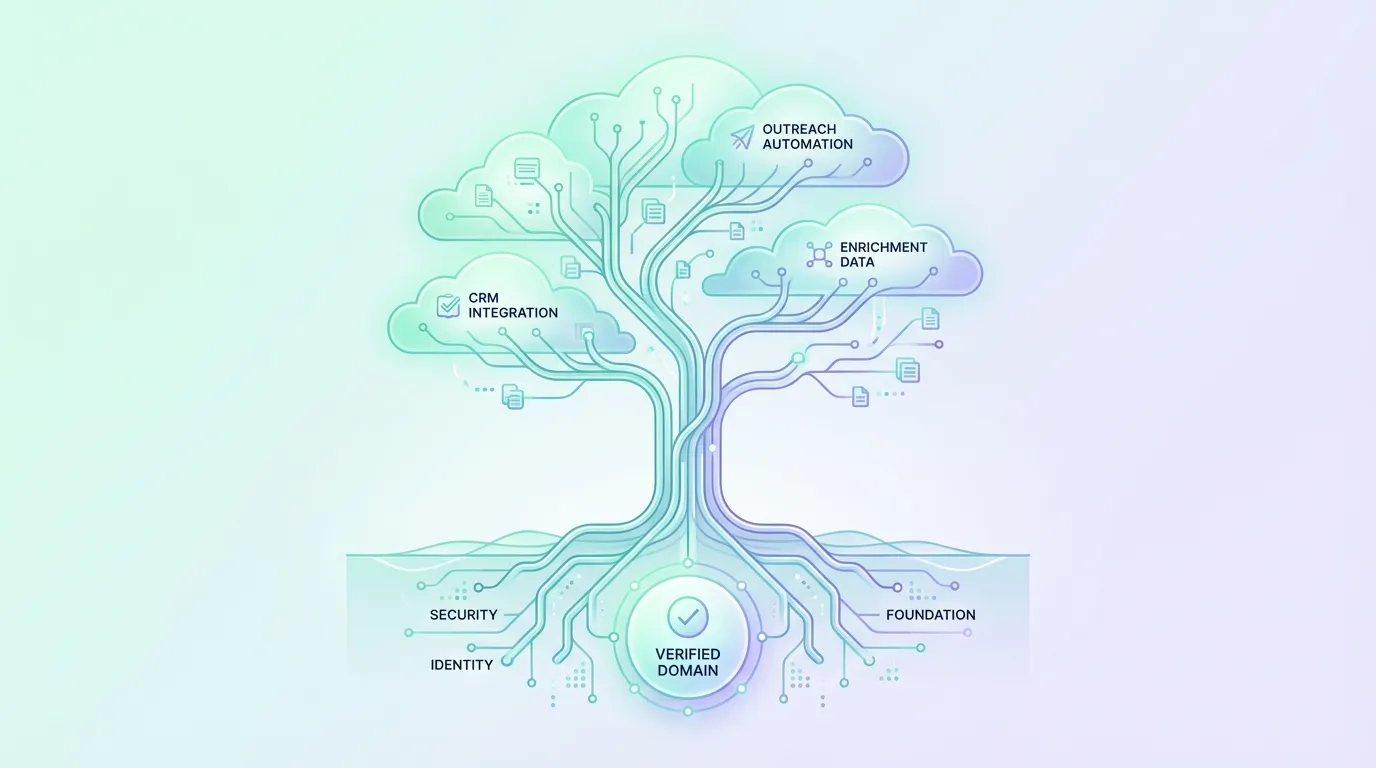
Company data is interconnected.
A single incorrect domain can affect:
- enrichment accuracy
- account scoring
- territory assignment
- automation rules
- reporting dashboards
Each downstream workflow assumes the company entity is correct.
If that assumption is wrong, the system does not fail immediately.
It slowly becomes less reliable.
The longer the error lives in the system, the more expensive it becomes to fix.
Domain verification as the first safeguard
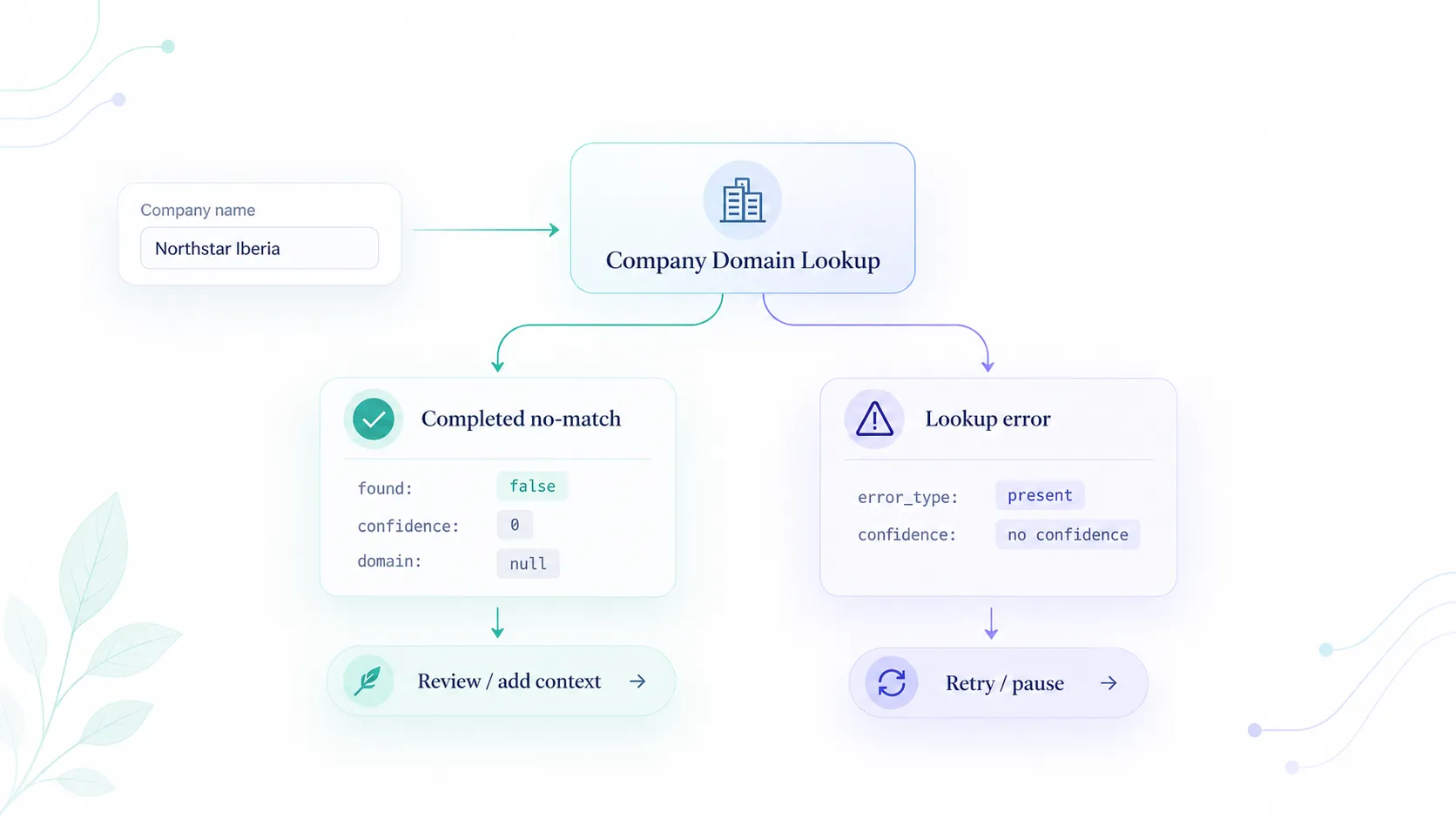
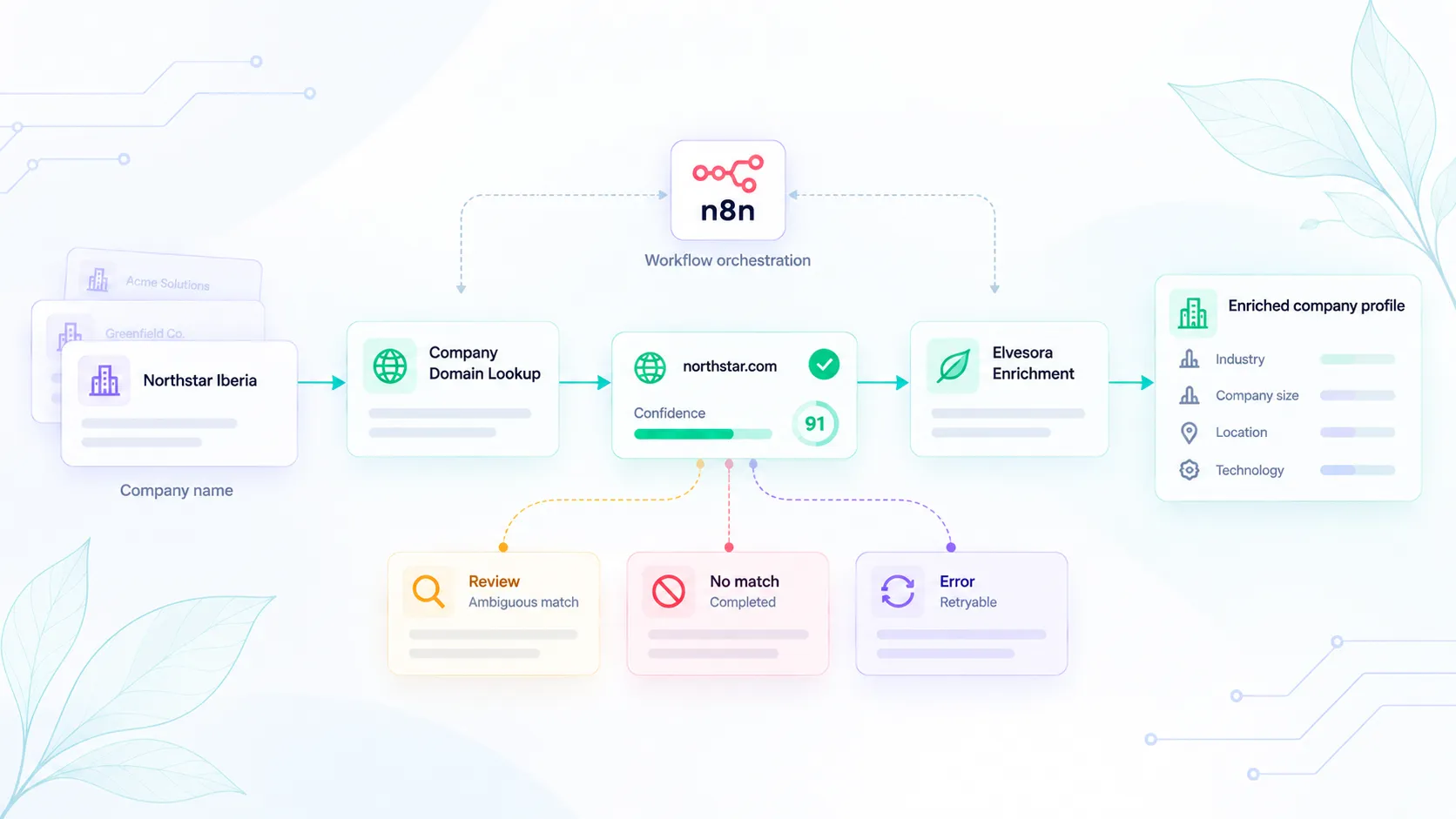
Modern company prospecting workflows reduce this risk by starting with structured company identification.
That means:
- normalizing company names
- verifying official domains
- confirming that the organization is active
- assigning confidence indicators
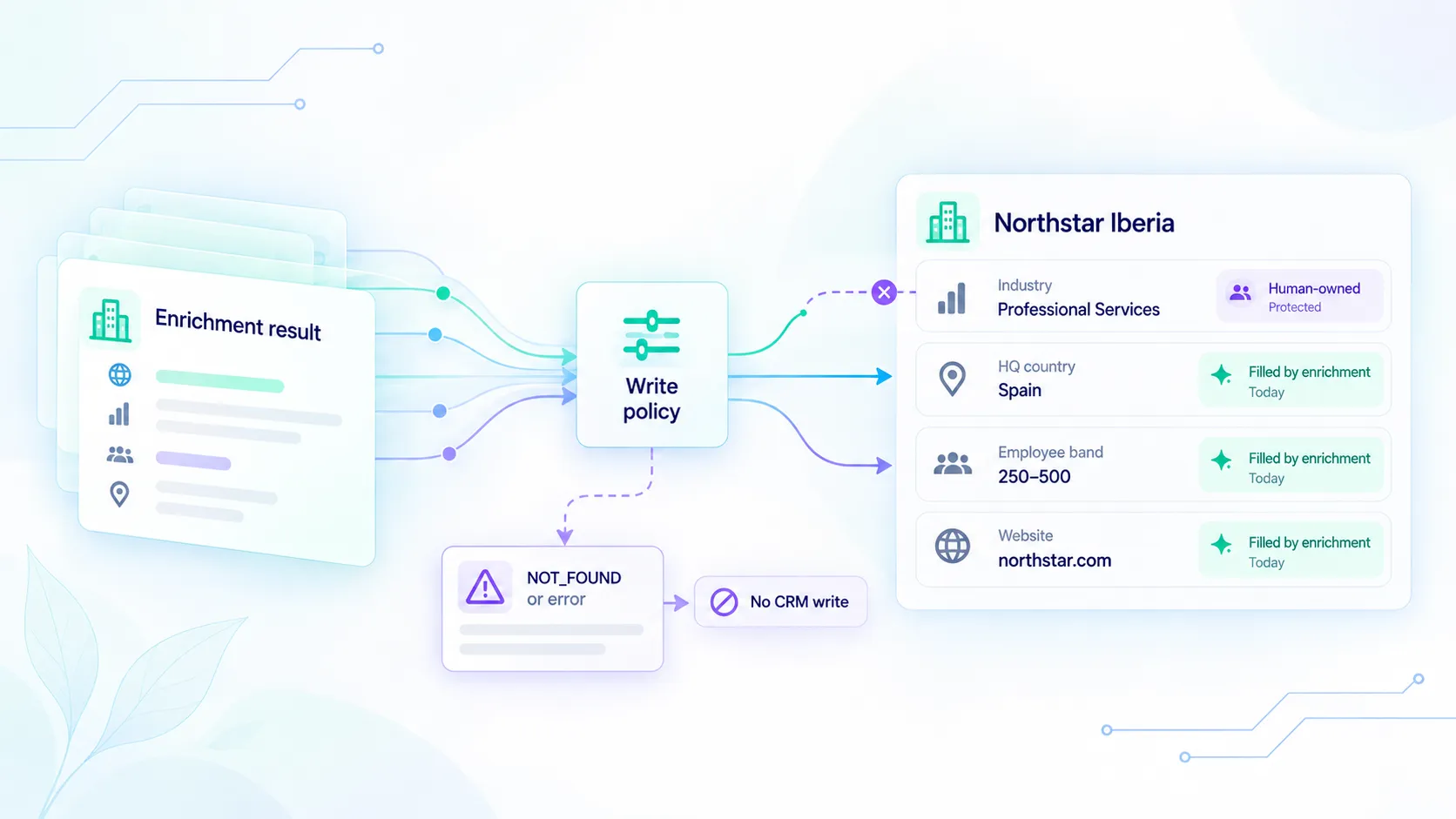
This step does not replace enrichment.
It protects it. It also ensures that contact-level validation and downstream workflows operate on reliable company data.
Domain lookup is not just a convenience feature.
In practice, it works as an early risk-reduction step in the workflow.
Where Elvesora fits
At Elvesora, company prospecting begins with verified company identity.
Our approach focuses on:
- company name normalization
- domain verification based on structured signals
- confidence scoring with explainable indicators
- confirmation that a company is live and operational
Only after the company entity is stable do enrichment and segmentation workflows begin.
By separating identification from enrichment, teams reduce ambiguity before it spreads across CRM and automation systems.
This makes prospecting easier to manage, easier to explain internally, and more reliable at scale.
Prospecting is a structural decision
It’s easy to think of prospecting as a top-of-funnel activity.
In reality, it is a data governance decision.
Incorrect company identification does not just reduce outreach efficiency.
It weakens the entire data ecosystem.
Accurate company identification, on the other hand:
- stabilizes enrichment
- protects segmentation
- improves reporting clarity
- increases sales confidence
Prospecting problems are often treated as volume problems.
In practice, they often begin much earlier, at the point where the company itself was never identified with enough confidence.
That is why one of the most important questions in any B2B workflow is also one of the simplest:
Are we working with the right company?
If you want a broader view of how modern teams approach this process, see how company prospecting tools are used to identify and prioritize the right accounts.