How email validation fits into clean data workflows
An explanation of how email validation fits into clean data workflows and why consistent decisions matter before enrichment and prospecting.

Email validation is often treated as a final checkpoint.
A quick filter before a form submission is accepted.
A last step before data enters a CRM.
In practice, validation plays a much bigger role.
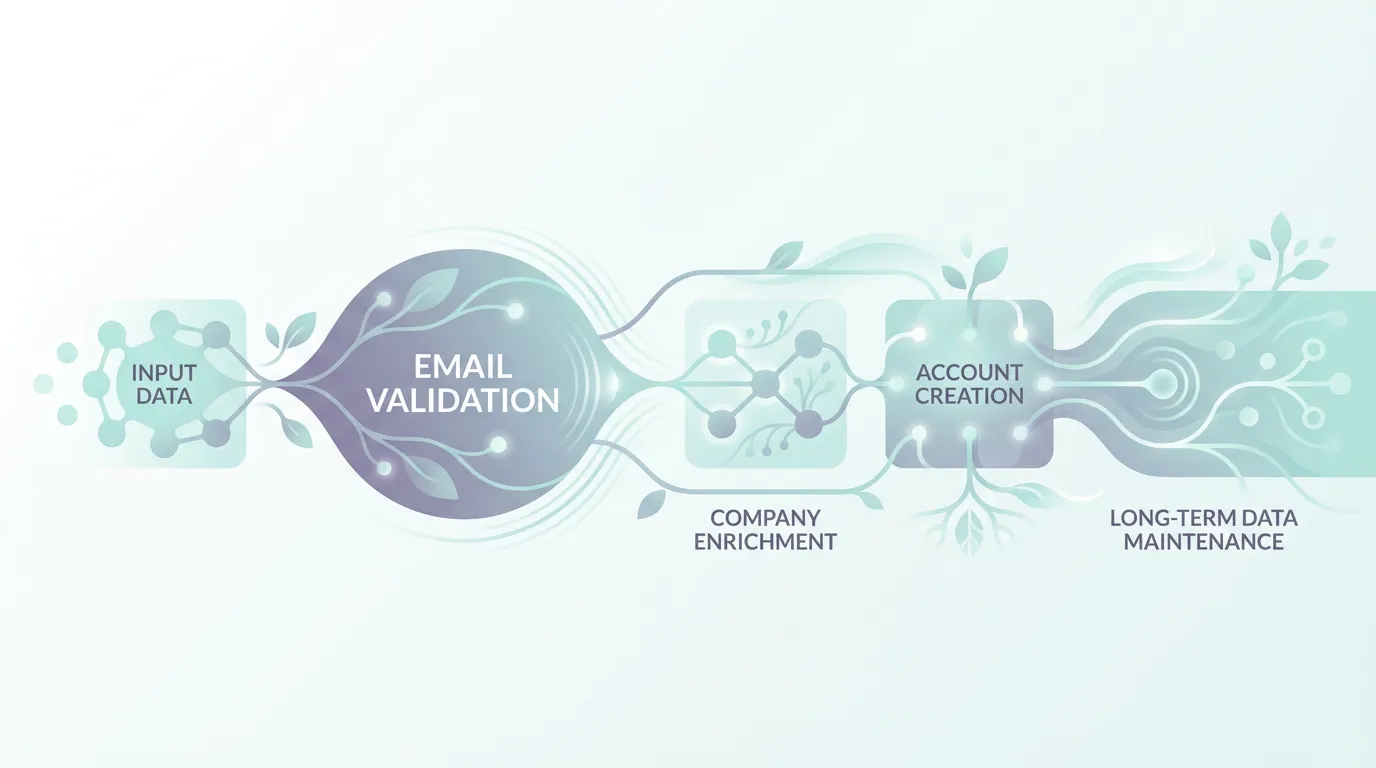
When done well, it shapes the quality of everything that follows - from enrichment to prospecting and long‑term data maintenance.
Email validation is not just about blocking bad data
Most validation tools focus on detection.
They answer questions like:
- Is this email disposable?
- Is the domain reachable?
- Does the address look risky?
Those signals are useful, but they are incomplete on their own.
What teams actually need is not just signals, but decisions.
To make those decisions consistent, teams need clearly defined validation rules. We go deeper into how to design them in How to Design Email Validation Rules for B2B Workflows.
Every email entering your systems forces a choice:
- Do we allow it?
- Do we block it?
- Or do we review it before moving forward?
Without a clear decision layer, the same signals can lead to different outcomes across products and teams.
That inconsistency is where data quality starts to break down.
Where email validation sits in a clean data workflow
Email validation is one of the earliest control points in a data pipeline.
It typically sits before:
- company enrichment
- account creation
- prospecting and outreach
- analytics and reporting
Decisions made at this stage directly affect what data enters your systems in the first place.
Allowing low‑quality or ambiguous emails doesn’t just create noise.
It creates downstream work:
- enrichment applied to records that shouldn’t exist
- duplicate or misattributed companies
- prospecting efforts built on unstable foundations
Clean workflows start by controlling what gets in.
Validation often breaks not because checks are missing, but because decisions are unclear.
Here’s a deeper look at why email validation fails without clear decision rules.
From signals to consistent decisions
The core challenge with email validation isn’t accuracy.
It’s consistency.
Different teams often implement validation rules in different places:
- frontend forms
- backend services
- internal tools
- automation workflows
Over time, those rules drift.
A disposable email might be blocked in one place and allowed in another.
A risky address might be silently accepted instead of reviewed.
This is how data quality erodes quietly.
Clean workflows require a single source of decision logic.
Policy‑based validation as a foundation
In a clean data workflow, validation works best when rules are defined once and applied everywhere.
A policy‑based approach allows teams to:
- define what “acceptable” means for their use case
- separate detection from decisioning
- keep outcomes predictable across products
Instead of hardcoding rules into every service, validation becomes a shared layer.
Signals go in.
Clear decisions come out.
How validation supports enrichment and prospecting
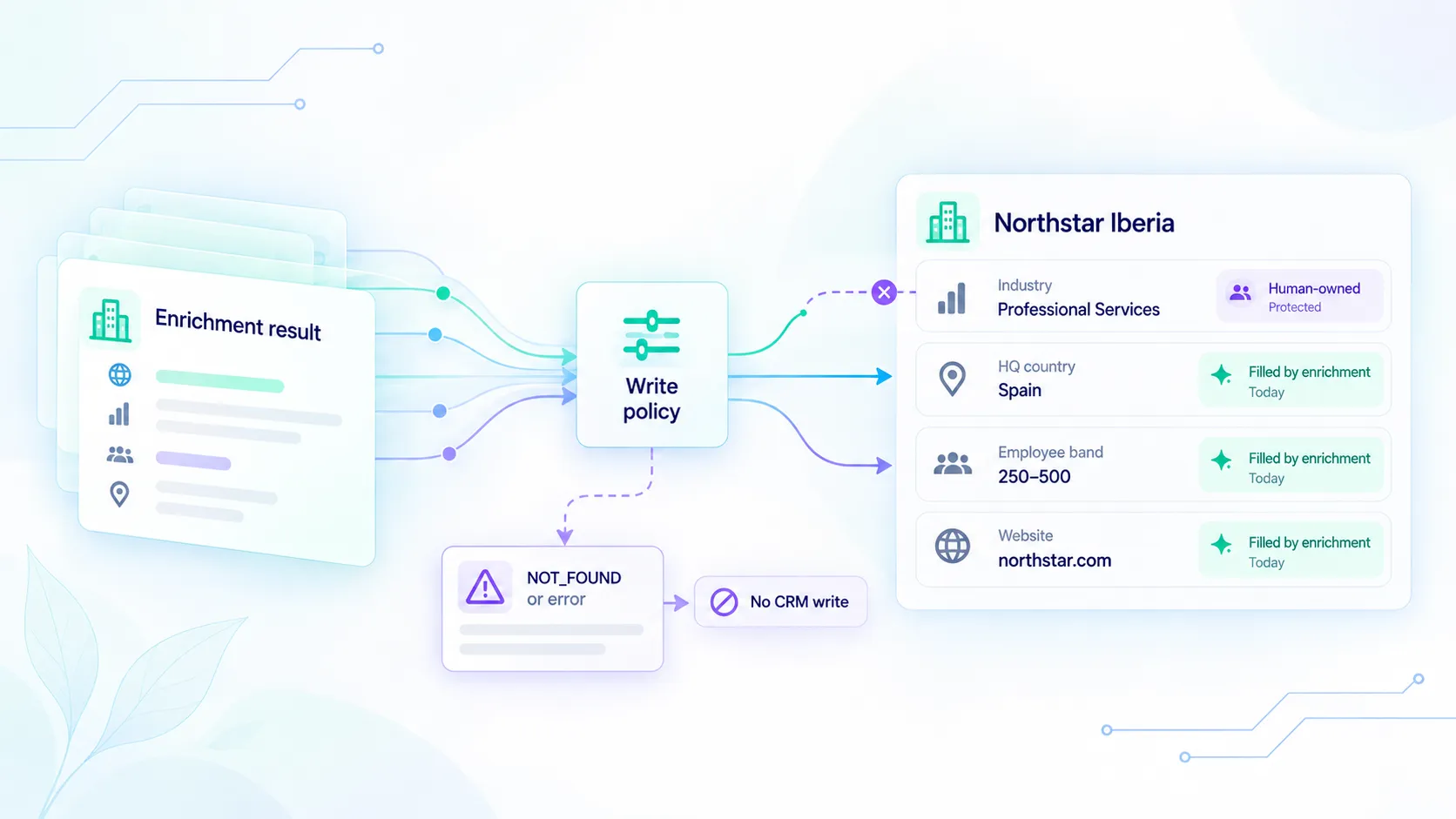
Email validation doesn’t replace enrichment.
It protects it.
When validation decisions are clear:
- enrichment is applied to records that are more likely to be real
- company identification becomes more reliable
- prospecting workflows work with cleaner inputs
This matters especially in B2B contexts, where:
- a single domain often represents an entire account
- enrichment is company‑level, not contact‑level
- downstream decisions depend on accurate attribution
Validation helps ensure enrichment effort is spent on the right records.
Validation, enrichment, and long‑term data health
Clean data isn’t maintained through one‑time fixes.
It’s maintained through systems that reinforce good decisions over time.
Email validation plays a recurring role in that system:
- preventing low‑quality entries
- reducing duplicate records
- limiting enrichment and prospecting drift
It reinforces the same decisions over time as part of a long-term clean data system.
When validation rules are explicit and consistent, data workflows become easier to understand, maintain, and trust.
Where Soryxa fits
Soryxa is designed as a decision layer for email validation.
Instead of returning signals alone, it applies team‑defined policy to produce a clear outcome:
- allow
- block
- review
By keeping validation rules centralized and consistent, teams can integrate email validation into clean data workflows without duplicating logic across systems.
Validation becomes predictable.
Downstream processes become more reliable.
Final thoughts
Email validation is often underestimated.
But in clean data workflows, it sets the tone for everything that follows.
Clear decisions at the point of entry make enrichment more effective, prospecting more accurate, and data systems easier to sustain over time.
Clean data doesn’t start with enrichment.
It starts with deciding what deserves to enter your system in the first place.