Soryxa vs NeverBounce: API Results and Workflow Control (2026)
Compare Soryxa and NeverBounce using current first-party API documentation, including real-time and bulk workflows, result categories, policy ownership, review handling, rollout controls, and verified pricing status.

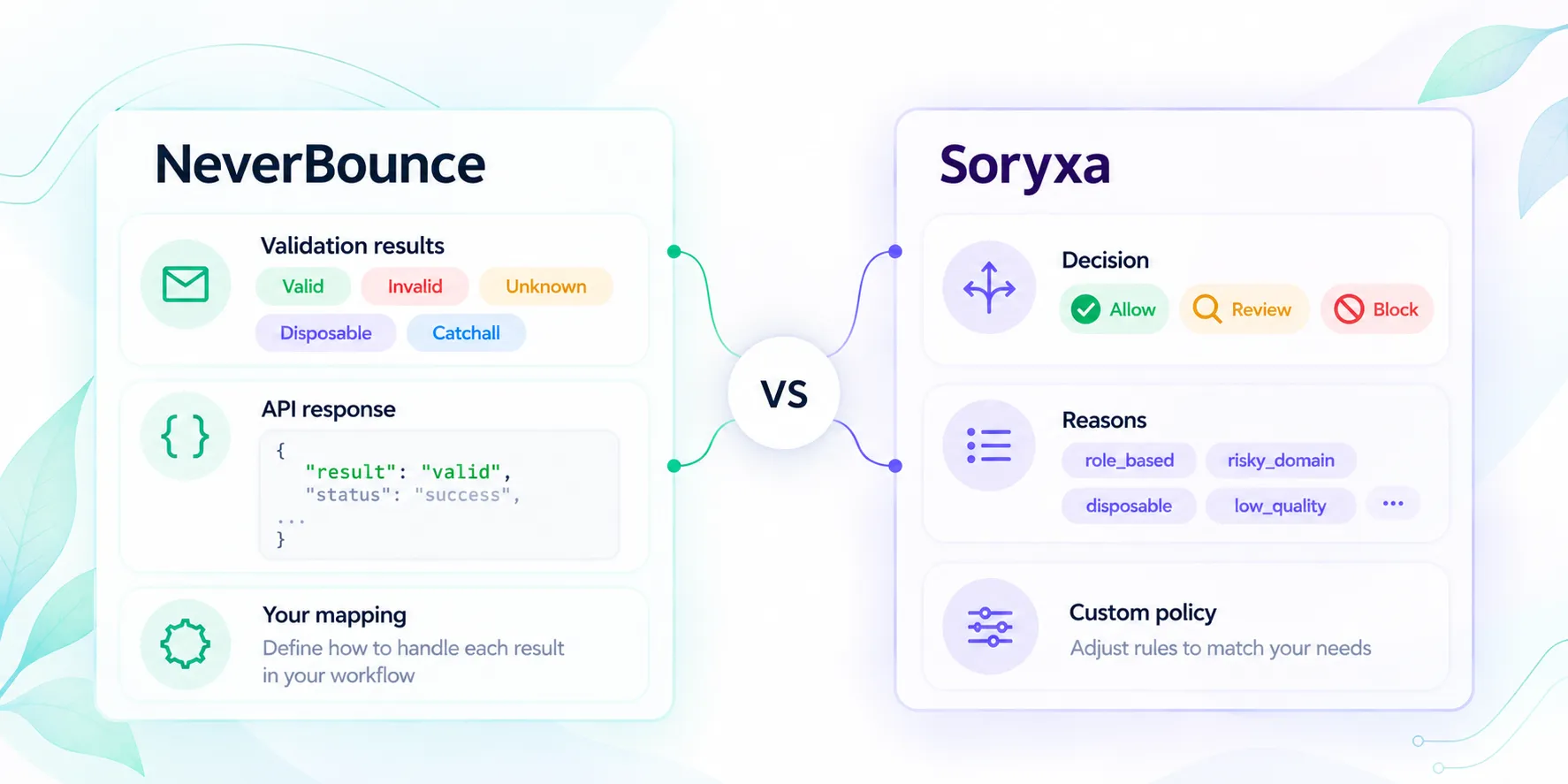
Soryxa and NeverBounce can both participate in real-time and bulk email-verification workflows. The main documented difference is what the application receives and who owns the policy after verification.
NeverBounce returns verification categories such as valid, invalid, disposable, catchall, and unknown, plus flags. The buyer maps those results into product behavior. Soryxa documents a policy layer that returns allow, review, or block with a reason code, score, and checks.
This comparison is based on accessible first-party documentation reviewed on October 22, 2026. It is not a hands-on accuracy benchmark. Elvesora, the company behind Soryxa, publishes it.
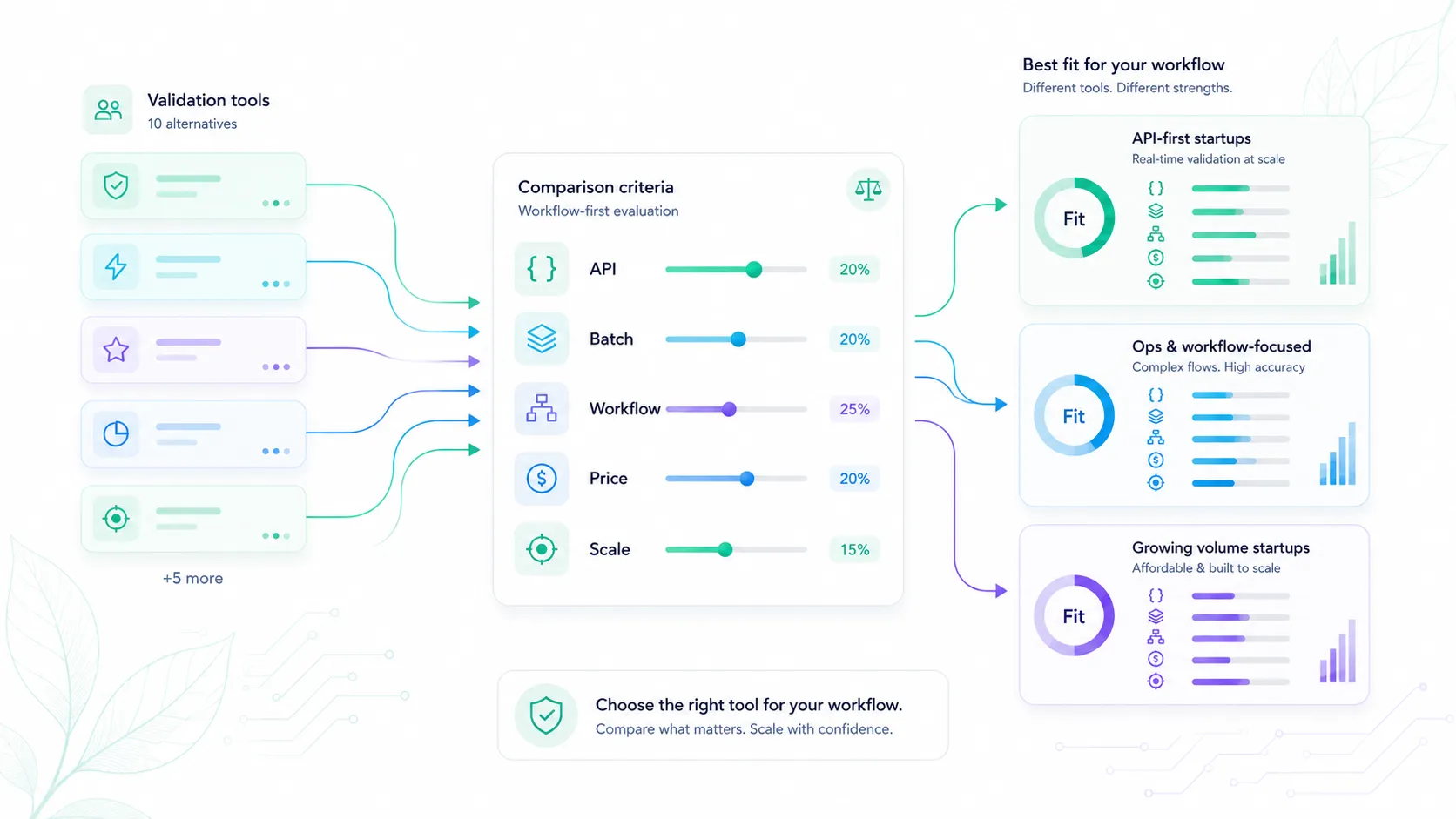
Comparison at a glance
| Criterion | Soryxa | NeverBounce | Evidence status |
|---|---|---|---|
| Real-time single-email API | Supported | Supported | Confirmed |
| Signup / point-of-entry use | Supported | Official guide documents signup/onboarding use | Confirmed |
| Bulk/list verification | JSON batch API with results and CSV export; dashboard operations for retries, policy re-runs, delta exports, and scheduled hygiene. | Asynchronous list jobs with deduplication, polling, and result download | Confirmed |
| Primary response model | allow, review, or block; reason code, message, score, and checks |
valid, invalid, disposable, catchall, or unknown; flags and suggested correction |
Confirmed |
| API response decision model | Documented | Buyer maps verification result to application policy | Confirmed with scope |
| Workflow labeling | policy_key identifies the calling workflow; it does not select a separate ruleset |
Equivalent response labeling not established in reviewed docs | Soryxa confirmed; NeverBounce Unknown |
| Published policy revisions and rollback | Documented | Not established in reviewed public docs | Soryxa confirmed; NeverBounce Unknown |
| Shadow/staged policy rollout | Documented | Not established in reviewed public docs | Soryxa confirmed; NeverBounce Unknown |
| Policy backtest | Documented with stated limits | Not established in reviewed public docs | Soryxa confirmed; NeverBounce Unknown |
| Native review queue | Documented | Not established in reviewed public docs | Soryxa confirmed; NeverBounce Unknown |
| Public list-API operating guidance | Documented | Documented, including batch sizing and polling | Confirmed |
| Current public price verified for this review | Free 250/month; $50/month for 25K; $90/month for 100K | Unknown | Soryxa confirmed; NeverBounce Unknown |
Sources reviewed: NeverBounce developer documentation covering single verification, list verification, usage guidelines, and JavaScript Widget configuration. Soryxa capabilities were checked against the Elvesora documentation referenced throughout this article.
An Unknown NeverBounce cell means the reviewed public documents did not establish the capability. It does not mean NeverBounce lacks it.
The key difference: verification result versus workflow decision
A verification category describes what the provider could determine about an address. A workflow decision describes what the buyer's application should do next.
NeverBounce's single-check example returns a result, flags, a suggested correction, and execution time. Its point-of-entry guide recommends allowing valid, catchall, and unknown results to proceed while blocking disposable and invalid. It also recommends treating request timeouts as unknowns.
That guidance is useful, but every product still has to decide whether the same rule fits:
- a free trial signup;
- a billing contact;
- a workspace owner;
- an imported CRM lead;
- an invitation;
- a marketing list.
Soryxa documents configurable team rules, published policy revisions, rollout controls, and a review queue. The optional policy_key identifies the calling workflow but does not select a separate ruleset. A response can include a normalized decision and a stable reason code, allowing the application to route a review outcome separately from an allow or block.
A result-to-policy mapping example
The following table is an application-policy example, not an official equivalence between the two vendors:
| NeverBounce result | NeverBounce point-of-entry guidance | Example buyer policy | Related Soryxa decision/reason pattern |
|---|---|---|---|
valid |
Allow | Allow normal signup unless another application rule fails | allow, often with a valid-classification reason |
invalid |
Block | Block and request a corrected address | block with an invalid-classification reason |
disposable |
Block | Block account ownership, or review for a low-risk content action | BLOCK_DISPOSABLE or DISPOSABLE_REVIEW, depending on policy |
catchall |
Allow | Allow a low-risk step, but review before irreversible routing or enrichment | Often review when policy treats uncertainty conservatively |
unknown |
Allow | Do not label as invalid; retry, allow a low-risk action, or send to review | review, including service-unavailable or threshold reasons where applicable |
The Soryxa examples use documented reason codes. This mapping illustrates possible application behavior, not equivalent classifications across providers.
NeverBounce also documents configurable acceptance and blocking behavior in its JavaScript widget, including accepted result codes and controls for free-email and role-account addresses. The distinction here is not that NeverBounce has no configurable behavior. It is that the reviewed documentation does not establish the same API decision model, published rule revisions, rollout controls, and review governance documented by Soryxa.
Do not automatically block every catch-all or unknown result. Do not automatically allow every risky result into a high-impact workflow. The policy should reflect the action's risk.
Real-time signup workflows
Both products document real-time use.
NeverBounce says its single endpoint can be integrated into signup or onboarding from a back-end application. It warns against exposing API credentials in client-side JavaScript and points browser implementations to its widget. It also notes that smaller mail hosts can take several seconds and recommends treating timeouts as unknown.
Soryxa documents a server-side validation request that returns a decision, reason code, score, checks, and usage fields. Its policy documentation separates mixed or temporarily unavailable results into review, so an uncertain validation result does not have to become a quiet allow or a hard block.
NeverBounce may fit when its documented result categories already map cleanly to an existing signup rule.
Soryxa may fit when applications need centrally managed rules, explicit review outcomes, and explainable decision history.
Bulk and list workflows
NeverBounce's current list guide documents an asynchronous pipeline:
- submit a remote CSV or supplied data;
- let the job index, deduplicate, and verify;
- poll the job status;
- retrieve the completed results.
Its usage guidelines separate single verification from bulk jobs and publish job-sizing and concurrency guidance.
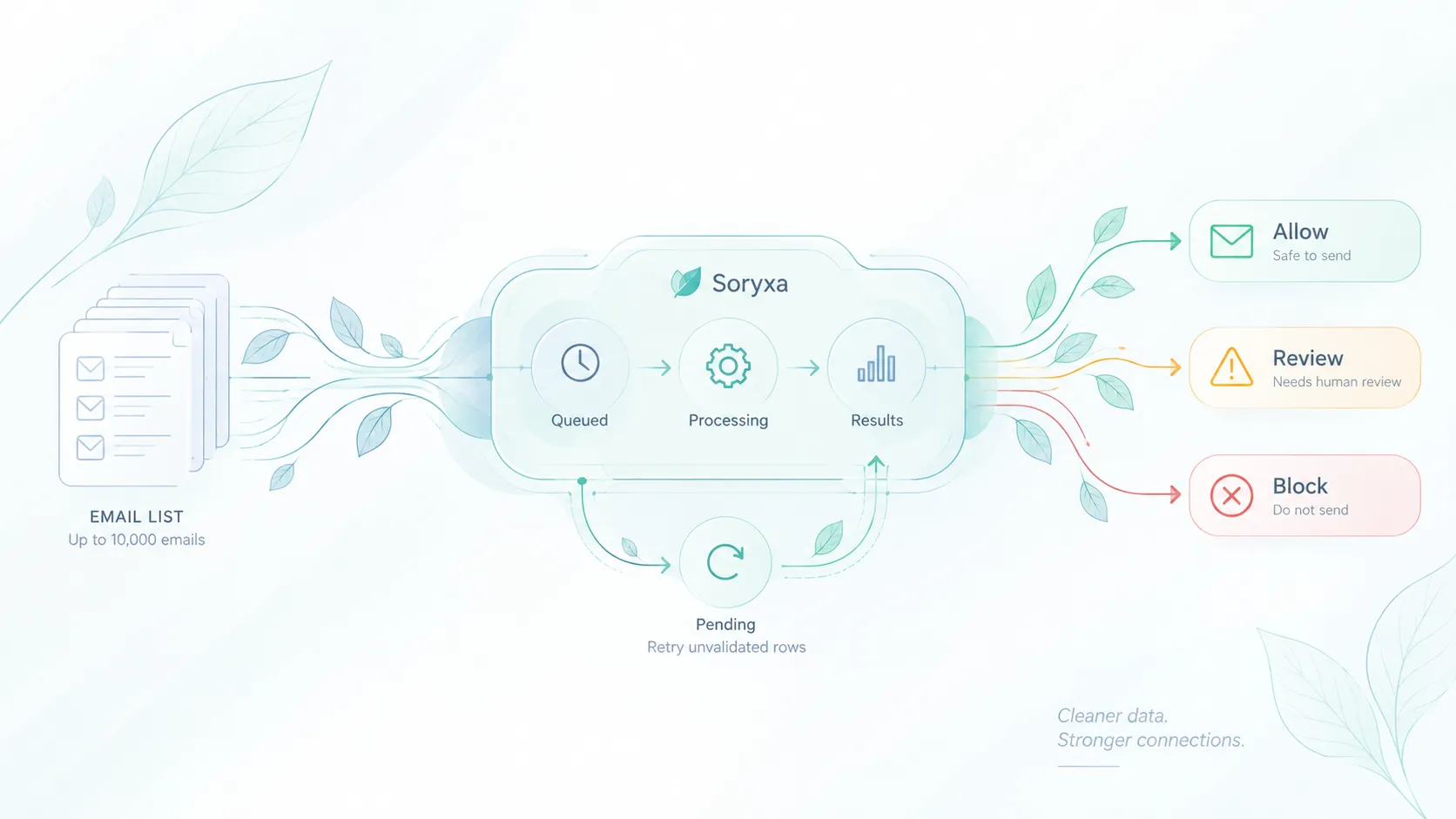
Soryxa batch documentation covers batch creation and results plus:
- filtering by row state or decision;
- retrying unvalidated rows without revalidating completed decisions;
- policy re-runs;
- delta exports;
- scheduled list hygiene;
- CSV output containing decision and reason fields.
The public batch API handles job creation, status, results, credits, export, and cancellation. Retry, re-run, delta export, and scheduled hygiene are available through the product dashboard.
NeverBounce may fit an established list-verification process where its job model and result categories already work for operators.
Soryxa may fit when batch records must pass through the same policy, review, and audit model used by live product workflows.
Policy revisions, rollout, and review
The current Soryxa rules documentation establishes:
- workflow labeling through
policy_key; - allow and block lists;
- disposable, free-provider, and role-account controls;
- review and optional block score thresholds;
- immutable published revisions;
- rollback;
- enforce, shadow, and staged rollout modes;
- backtests for documented rule inputs;
- a review queue with decision history.
The reviewed public NeverBounce developer pages did not establish an equivalent governance layer. That is an Unknown, not a claim that no account-level or enterprise capability exists.
This difference matters most when a team expects policy to change. A result parser can be simple on day one and still become hard to govern when signup, CRM imports, invitations, and billing contacts require different handling decisions, consistent rule governance, and an explainable review process.
Pricing status
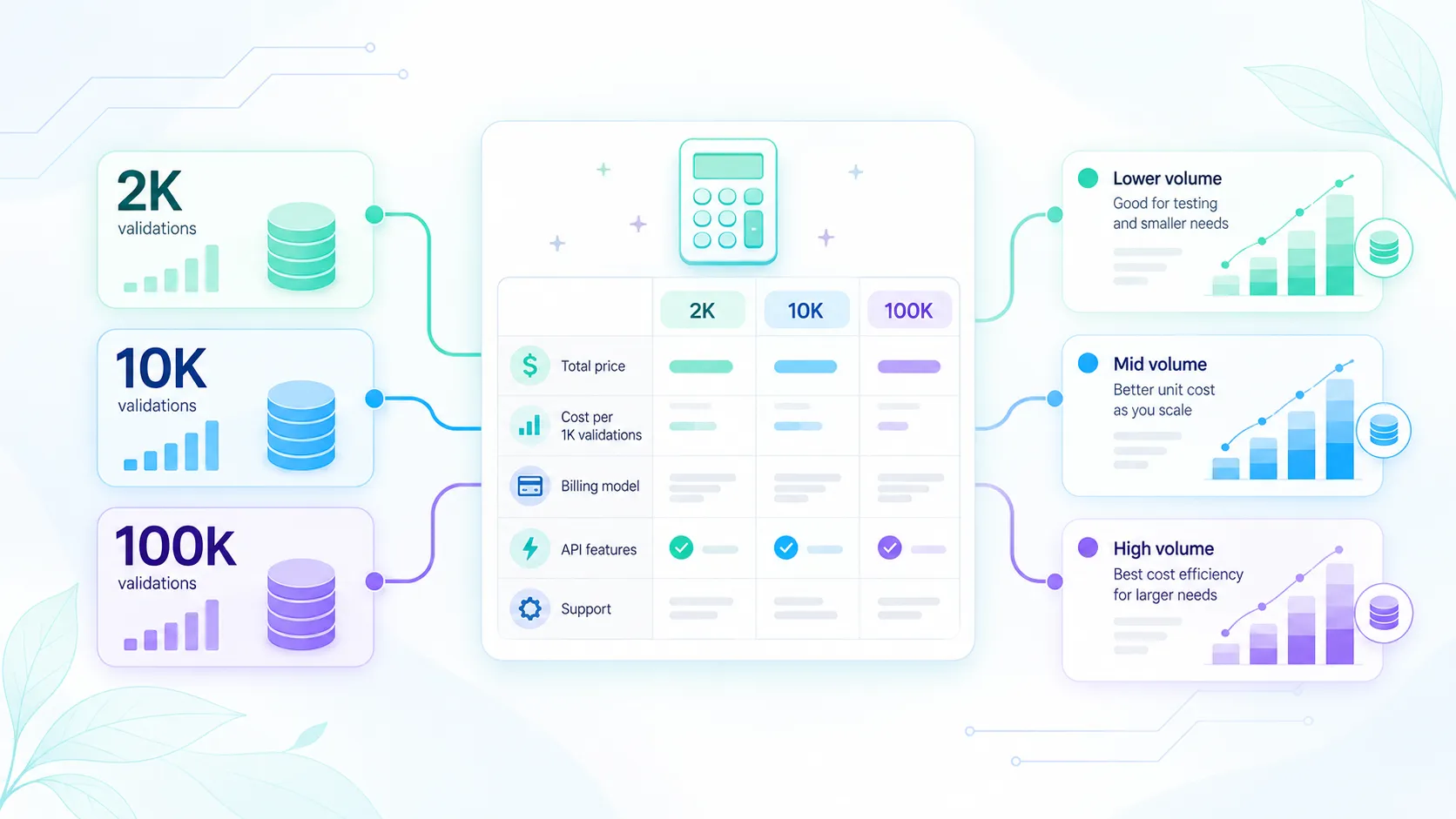
Current Soryxa list pricing was verified on its public pricing page:
- Free: 250 validations/month
- Starter: $50/month for 25,000
- Growth: $90/month for 100,000
The current NeverBounce public price could not be independently verified from an accessible first-party page in this review. It remains Unknown; this article does not use a reseller, aggregator, or old comparison post as a substitute.
Ask NeverBounce for the price and terms that apply to the actual account and expected volume. Then compare the billing shape with Soryxa's monthly capacity. Price should not be inferred from the presence or absence of a public calculator.
When Soryxa is the better fit under declared criteria
Evaluate Soryxa first when:
- the API must return an application-ready decision;
- mixed signals need a visible review state;
- signup and CRM intake need traceable workflow labels and centrally governed validation rules;
- policy changes need revisions, rollback, shadow/staged rollout, or supported backtests;
- batch and real-time validations should share decision semantics;
- support or operations must explain why a record was allowed, reviewed, or blocked.
This is a workflow-fit recommendation. It is not a claim that Soryxa is more accurate or faster than NeverBounce.
When NeverBounce may be the better fit
Keep NeverBounce when:
- the team already has a working NeverBounce integration and operations process;
valid,invalid,disposable,catchall, andunknownalready map safely to internal rules;- list jobs, downloads, and existing operator habits are the main workflow;
- the current NeverBounce account price is acceptable;
- replacing the vendor would add migration risk without solving a documented policy problem.
Do not migrate merely to reduce the number of vendors. Migrate when the new result and governance model solves a measured workflow problem.
Run a reversible comparison
Before changing production behavior:
- Pick one entry point, such as signup or a CRM import.
- Write the desired action for each result category before looking at vendor output.
- Use a permissioned, representative sample.
- Run both products beside the current production path without changing user outcomes.
- Store source result, source flags/checks, proposed decision, latency, error state, and review outcome.
- Manually inspect disagreements.
- Measure integration effort and review volume.
- Move only the workflow whose evidence supports the change.
If no common sample is run, describe the decision as documentation-based. Do not claim an accuracy winner.
Migration from NeverBounce without a big-bang switch
A low-risk migration pattern is:
- Keep NeverBounce unchanged for current list operations.
- Run Soryxa alongside NeverBounce for one application entry point without allowing the new integration to change production outcomes.
- Map the current NeverBounce result categories and the proposed Soryxa decision to a shared evaluation record.
- Review disagreements without blocking users.
- Publish a Soryxa policy only after the team agrees on the actions.
- Use staged rollout before broad enforcement.
- Retain NeverBounce for workflows where it continues to fit.
Soryxa's shadow and staged rollout modes can then be used to evaluate changes to its own published rules. They are separate from the application's parallel-vendor comparison.
The objective is not to force every email check into one product. Keep the workflows that already work, test proposed changes without affecting users, and migrate only where the new decision and governance model solves a measured problem.
A useful vendor comparison should make that decision explainable, not simply declare a winner.