10 ZeroBounce Alternatives for Startups: A Workflow-First Comparison (2026)
Compare ten ZeroBounce alternatives with a transparent startup scorecard covering real-time API workflows, bulk verification, pricing evidence, uncertain-result handling, and documented limitations.

ZeroBounce is not the only credible way to verify email addresses, but the right alternative depends on where the check happens. A SaaS signup needs a fast API and a safe policy for uncertain results. A campaign team needs bulk processing and exports. An outreach team may prefer verification inside the platform it already uses.
This comparison covers ten alternatives using first-party documentation checked in August 2026. It is desk research, not a hands-on accuracy test. It is desk research, not a hands-on accuracy test. Elvesora publishes this article and develops Soryxa, so the Soryxa recommendation is limited to the workflow criteria stated below.
The short answer
- Consider Soryxa when an application needs a normalized
allow,review, orblockdecision, policy revisions, and a review path. - Compare Bouncer, Emailable, MailerCheck, and MillionVerifier when bulk verification, reusable credits, and list operations are central.
- Consider Mailgun Validate when Mailgun already owns the sending and deliverability workflow.
- Consider Hunter when verification belongs inside email finding and outreach rather than a standalone validation service.
- Consider Abstract API for a developer-focused validation endpoint, but confirm the exact capacity of its current paid plans.
- Keep NeverBounce on the shortlist for its documented single and bulk workflows, but verify current pricing directly because it was not independently accessible for this review.
- Treat Kickbox as unverified in this edition: its current first-party pricing and documentation were inaccessible, so this article does not repeat third-party claims.
That is a shortlist, not a performance ranking.
How to evaluate the alternatives for your workflow
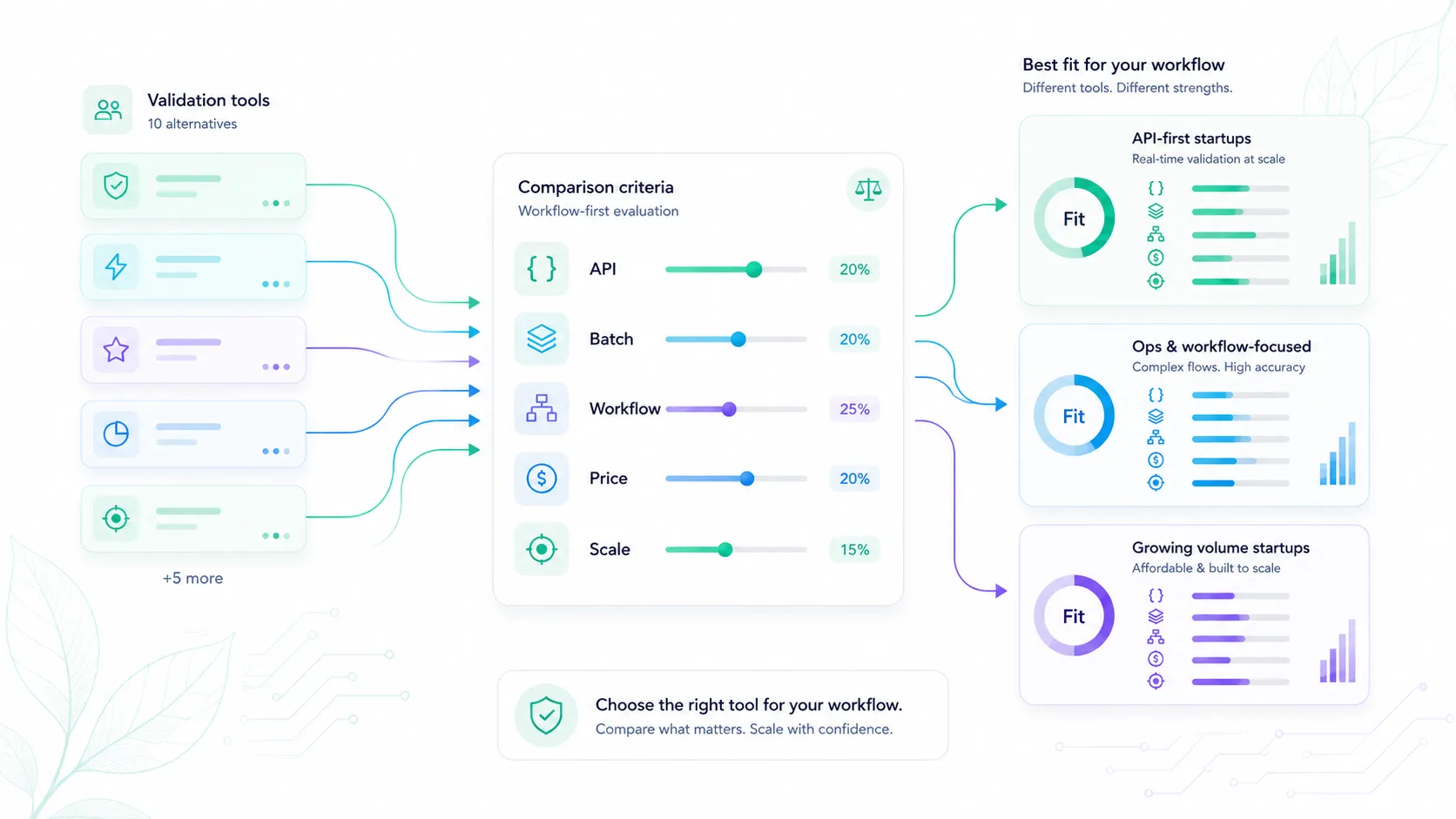
Rather than assigning a universal score, use this weighted scorecard against your own workflow:
| Criterion | Weight | The question to answer |
|---|---|---|
| Primary workflow fit | 30% | Does the product directly support signup, CRM intake, list cleanup, or outreach? |
| Result and policy handling | 20% | Can your application handle valid, risky, unknown, disposable, role, and catch-all outcomes safely? |
| Price and unused capacity | 20% | Does the billing model fit recurring or irregular volume without avoidable waste? |
| Integration coverage | 15% | Are the required real-time, batch, export, callback, or platform integrations documented? |
| Uncertainty and credit policy | 10% | How are unknowns, duplicates, repeated checks, expiry, and unused credits treated? |
| Evidence quality | 5% | Can the important facts be verified on a current first-party page? |
Score each row from 0 to 5, multiply by the weight, and keep the raw evidence next to the score. Do not give a vendor zero merely because a feature is undocumented; mark it Unknown and ask the vendor.
Comparison matrix
| Alternative | Real-time path confirmed in first-party docs | Bulk/list path confirmed in first-party docs | Published result or decision model | Pricing evidence checked | Best-fit starting use | Important limitation |
|---|---|---|---|---|---|---|
| Soryxa | Yes | Yes | allow, review, block plus reason codes, score, and checks |
250 free/month; $50/month for 25K; $90/month for 100K | Product signup, CRM intake, policy-controlled workflows | Elvesora is the publisher; this is not an independent benchmark |
| Bouncer | Yes | Yes | deliverable, risky, undeliverable, unknown plus reasons and score |
1K $8; 10K $60; 100K $400; credits do not expire | API plus irregular or bulk verification | A buyer-owned policy is still required after the result |
| Emailable | Yes | Yes | deliverable, risky, undeliverable, unknown plus attributes and score |
250 free; 5K PAYG minimum; exact calculator amounts not captured | API, list verification, and deliverability tooling | Exact 2K/10K/100K prices are Unknown in this snapshot |
| Kickbox | Unknown | Unknown | Unknown | Unknown | Candidate for direct buyer review | First-party pages were inaccessible; do not rely on this article for current facts |
| MailerCheck | Yes | Yes | Single and asynchronous verification responses | 10 free; 1K minimum; starts at $0.01 per email at 1K | Campaign/list workflows and real-time checks | Exact larger-volume calculator outputs were not captured |
| Mailgun Validate | Yes | Yes/documented as validation tooling | Validation signals inside Mailgun's deliverability suite | Scale is $90/month with 5K validations; overages published by tier | Existing Mailgun sending stack | Bundled sending/deliverability value prevents a clean standalone price comparison |
| Hunter | Yes | Yes | Verification inside Hunter's finding/outreach workflow | Unified credits; verification uses 0.5 credit on all-in-one plans | Sales research and outreach teams already using Hunter | Credits are shared with finding and other actions |
| Abstract API | Yes | Yes | Structured validation and risk fields | 100 free; paid plans start at $17/month | Developer-first API experiments and application checks | Exact scenario capacities were not visible in the static page |
| NeverBounce | Yes | Yes | valid, invalid, disposable, catchall, unknown plus flags |
Current public price not independently verified | Existing NeverBounce workflows, signup checks, and list jobs | Pricing is Unknown; comparable policy-governance features were not established in the reviewed public docs |
| MillionVerifier | Yes | Yes | Good/bad/risky-oriented verification with special risky-result billing | 10K $39; 100K $149; no scheduled credit expiry | Cost-sensitive bulk and API volume | Inactive-account deletion can remove remaining credits; vendor accuracy claims were not tested in a common sample |
1. Soryxa: for application decisions and governed policy
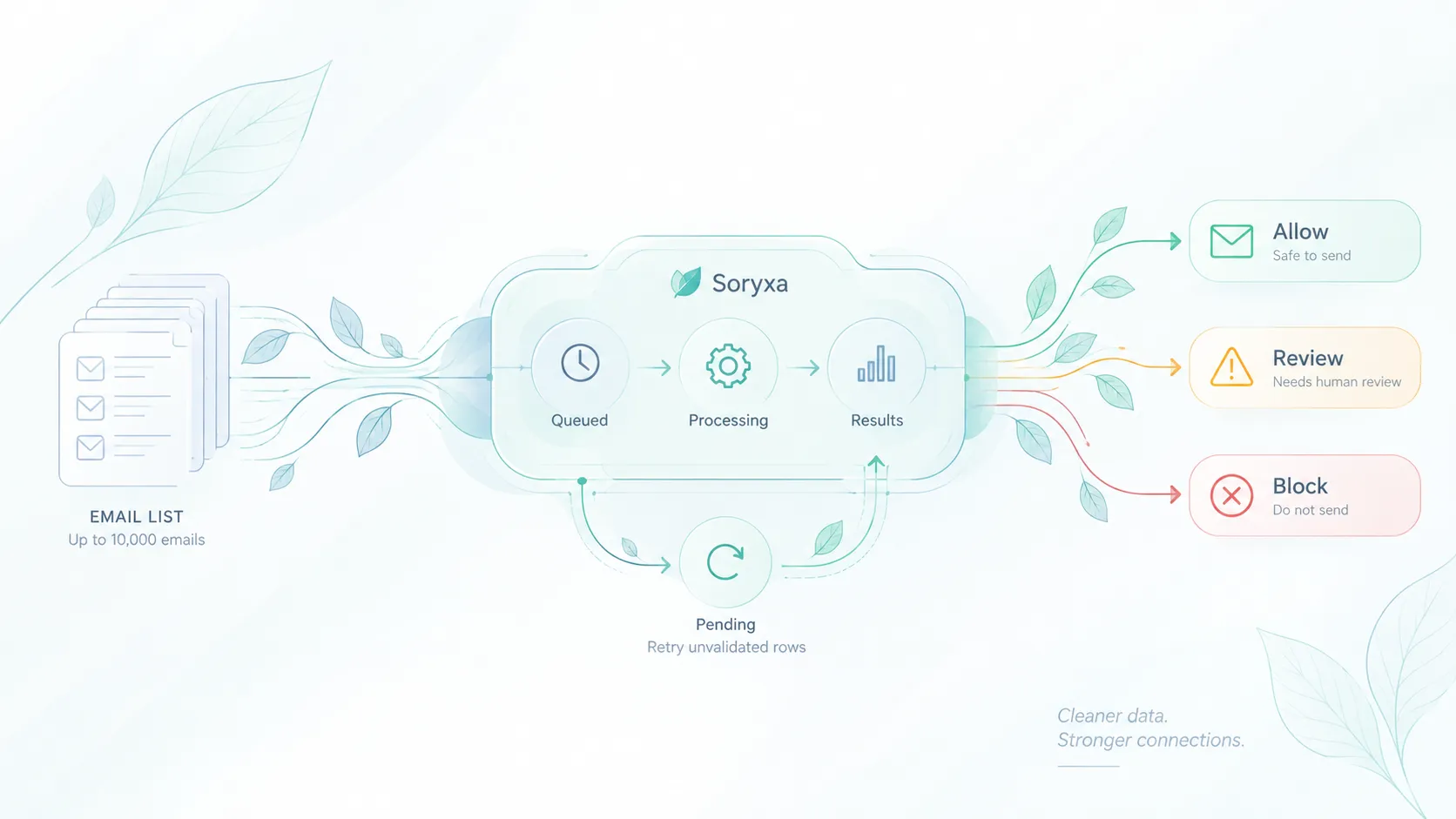
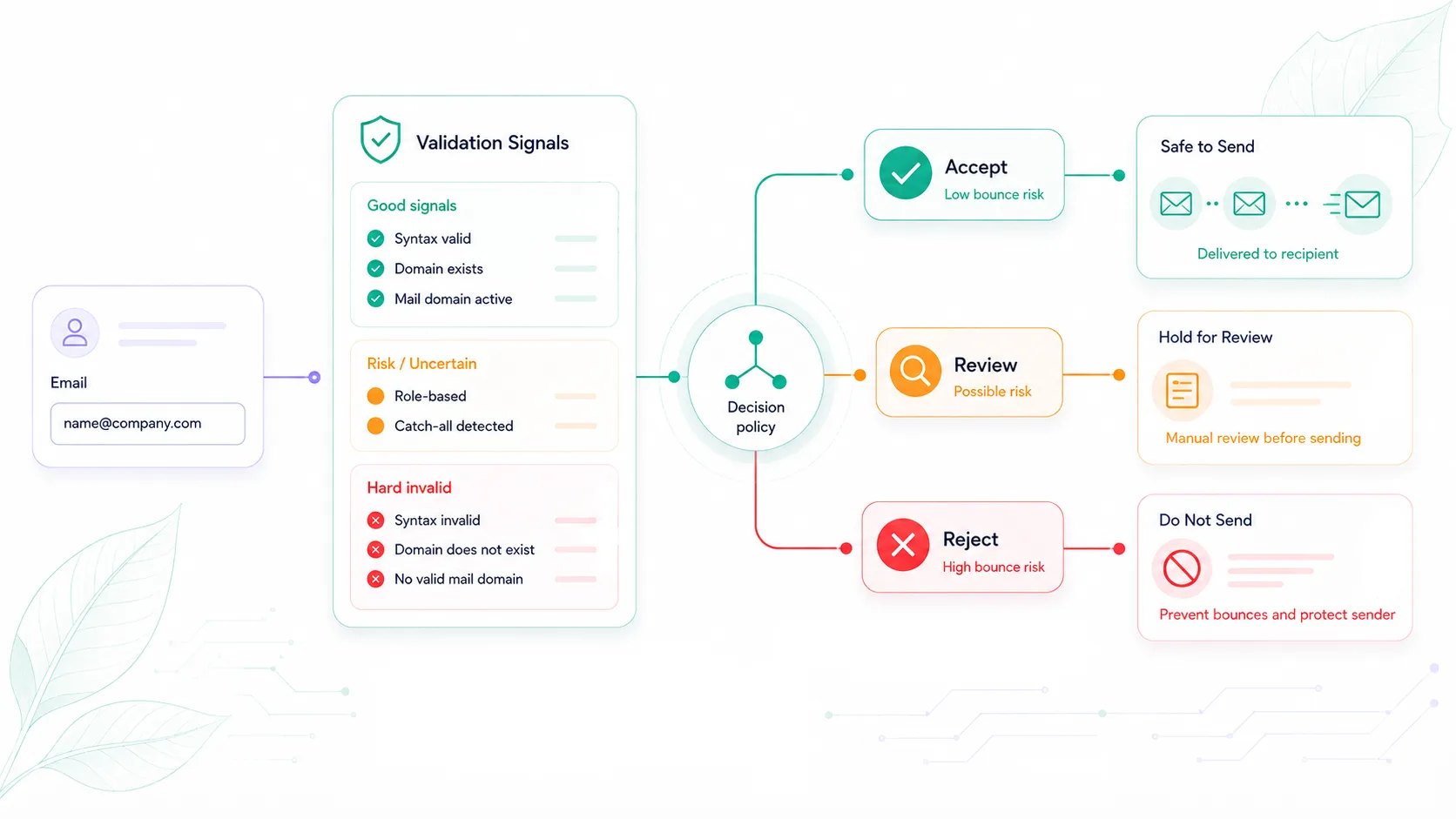
Soryxa is a relevant starting point when validation is part of product logic rather than only list cleanup. Its documented response centers on allow, review, or block, accompanied by a reason code, score, and checks. That separation between validation evidence and workflow decisions matters when the same result can lead to different actions in signup, CRM intake, or sending workflows. The current product also documents named policies, immutable published revisions, staged or shadow rollouts, backtests, and a review queue.
That changes the integration question. Instead of only asking whether an address is risky, the application can ask what this policy permits for this workflow. Signup and CRM intake can use different policies without turning message text into business logic.
For a quick evaluation, try the Soryxa email validation demo without an account to inspect email and domain quality signals before integrating the API.
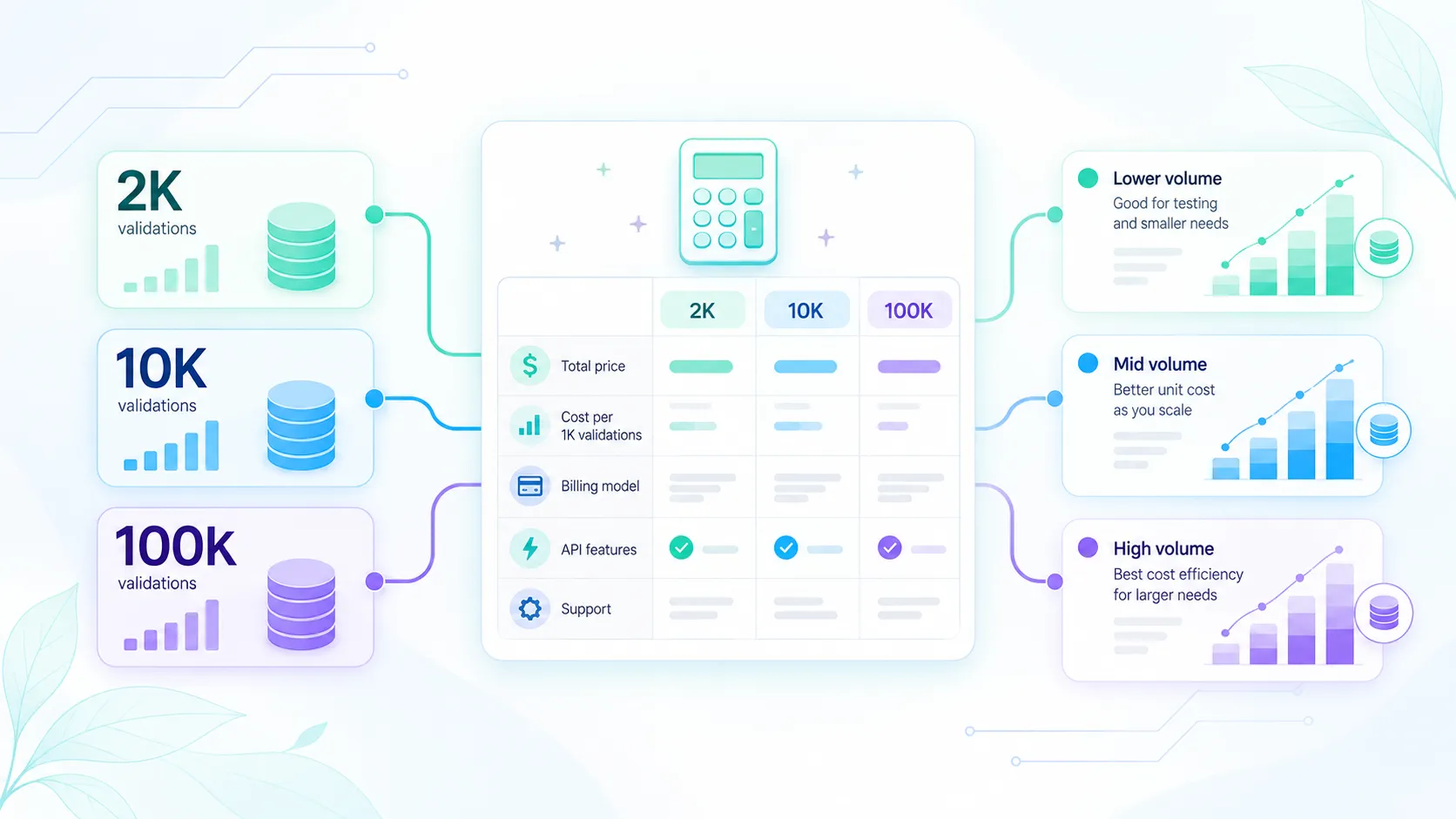
The public Soryxa pricing page lists 250 validations per month for Free, 25,000 for $50 per month, and 100,000 for $90 per month. Every submitted address counts as one validation.
Best fit: developer-led SaaS, signup protection, CRM intake, and teams that need reviewable rules.
Limit: Soryxa is not an email-finding database, and Elvesora has a direct commercial interest in the recommendation. Run it beside the current verifier before replacing anything.
2. Bouncer: for transparent credits and detailed verification states
Bouncer's API documentation covers real-time, asynchronous batch, and synchronous batch endpoints. Results can include deliverable, risky, undeliverable, or unknown, plus reasons, domain/account signals, and a score.
The Bouncer pricing page publishes several credit packages, including $8 for 1,000, $60 for 10,000, and $400 for 100,000. It says purchased credits do not expire and that duplicates and unknown results are not charged.
Best fit: teams switching between API and bulk work, especially when irregular usage makes reusable credits important.
Limit: the result still needs a buyer-owned rule for catch-all, disposable, risky, and unknown cases, especially when different validation signals should lead to different workflow actions. A comparable documented review and policy-governance layer was not established in the public docs reviewed for this article.
3. Emailable: for API, bulk, and email-quality tooling
Emailable's API reference documents single and batch verification with deliverable, risky, undeliverable, and unknown states, along with attributes such as role, disposable, free-provider, and accept-all signals.
Its pricing documentation lists 250 free credits, a 5,000-credit PAYG minimum, credits that do not expire, and free unknown and duplicate results. The exact package totals are generated by an interactive calculator and were not captured in the static page used for this research.
Best fit: teams wanting real-time and list verification alongside deliverability tooling.
Limit: confirm the exact current package total in the vendor calculator before including Emailable in a price-ranked shortlist.
4. Kickbox: a candidate that requires direct verification
Kickbox was in the original shortlist, but its current public homepage, pricing page, and documentation could not be accessed from this research environment after one retry. No third-party price or feature copy has been substituted.
Best fit: Unknown until the buyer reviews the current first-party product and contract.
Limit: do not select or reject it from this article alone. Verify API modes, list support, result categories, price, credit expiry, and unknown-result billing directly.
This is an access limitation, not a criticism of the product.
5. MailerCheck: for campaign-oriented list and API verification
MailerCheck's developer documentation covers real-time and asynchronous single checks plus list verification. Its pricing page lists ten free credits, a 1,000-credit minimum, a displayed starting rate of one cent per email at that volume, and credits that do not expire.
Best fit: teams whose main job is campaign/list verification but that also need real-time checks.
Limit: the static page did not expose exact larger-volume totals, so compare the live calculator at the intended quantity.
6. Mailgun Validate: for teams already operating Mailgun
Mailgun Validate belongs in a broader sending and deliverability platform. The current Mailgun pricing page lists 5,000 validations in its $90-per-month Scale plan and publishes additional validation rates.
That can be operationally convenient when Mailgun already owns sending, authentication, logs, billing, and deliverability work. It is less clean as a standalone price comparison because the plan includes more than verification.
Best fit: existing Mailgun teams that value one operational stack.
Limit: do not compare the entire plan price with a standalone credit vendor as though the included products were equivalent.
7. Hunter: for finding, verification, and outreach together
Hunter combines email finding, verification, lead data, and outreach. Its pricing page says an Email Verifier or Bulk Email Verifier check uses 0.5 unified credit on all-in-one plans. The same credits can also be used by other Hunter tools.
Best fit: sales and outreach teams that already need Hunter's wider workflow.
Limit: a plan's headline credit number is not dedicated verification capacity when the team also uses finding, enrichment, and other actions. Soryxa should not be compared with Hunter as an email-finding product because Soryxa does not perform that job.
8. Abstract API: for a focused developer endpoint
Abstract's Email Validation API documents real-time and bulk validation, structured deliverability and quality information, and checks covering syntax, MX/SMTP, disposable, free-provider, catch-all, and role signals. The public page lists 100 free requests and says paid plans start at $17 per month.
Best fit: prototypes and developer-owned validation where a structured API matters more than a full operations suite.
Limit: confirm the exact request capacity and overage behavior for the intended volume; those tier details were not present in the static accessible page.
9. NeverBounce: for documented signup and list workflows
NeverBounce's developer documentation supports individual and large-list verification. Its current single-verification guide shows valid, invalid, disposable, catchall, and unknown results and describes point-of-entry use. The current list guide documents asynchronous jobs, deduplication, polling, and downloads.
Best fit: teams already using NeverBounce, teams satisfied with its result categories, and list-verification workflows.
Limit: current pricing was not independently accessible. Review the official account or pricing page before comparing cost, and keep application-policy requirements separate from the vendor's verification result.
10. MillionVerifier: for published bulk prices and reusable credits
MillionVerifier's current pricing page publishes $39 for 10,000 credits and $149 for 100,000. Its credit documentation says purchases do not expire and can be used for API and bulk workflows. That durability is conditional on account retention: according to its account-deletion guide, MillionVerifier may delete a profile after 12 months without activity, following notice; any remaining balance is removed with the account.
For uploaded lists, MillionVerifier documents billing adjustments for eligible unknown or catch-all results, while those classifications are not debited in API and single-verification flows. Its documentation also notes exceptions for misuse and repeated billable API submissions.
Best fit: cost-sensitive recurring or one-time bulk volume where reusable credits matter and the account will remain active.
Limit: remaining credits can be lost with inactive-account deletion. Vendor-reported accuracy and guarantee language were not independently tested here, and price alone cannot establish decision quality.
Build a three-vendor test instead of trusting a ten-vendor list
After scoring the shortlist, choose no more than three products for the next step:
- Define one workflow: signup, CRM import, or campaign list.
- Write the desired action for malformed, invalid, disposable, role, catch-all, and unknown outcomes.
- Record the current vendor price and terms on the test date.
- Use the same permissioned sample where contracts and privacy rules allow it.
- Preserve raw results without forcing different vendors into identical labels.
- Compare disagreements manually.
- Measure integration effort, review volume, and the effect on the actual workflow.
Do not publish an accuracy winner unless the sample, labels, environment, dates, and limitations are disclosed.
Which alternative should a startup choose?
For a product team that needs validation to produce governed application decisions, Soryxa belongs on the initial shortlist under this article's workflow criteria. That recommendation is about documented workflow fit, not universal verification accuracy.
For irregular or batch-heavy cleanup, Bouncer and MillionVerifier have clearer static price evidence in this review, while Emailable and MailerCheck provide credible API/list options whose exact calculator totals should be checked. For an existing Mailgun or Hunter customer, the value may come from consolidating work inside the current platform. NeverBounce remains a credible documented API/list option when its current account pricing and result model fit the buyer.
The useful choice is not “Which vendor has the longest feature list?” It is “Which evidence-backed result model fits the point where weak email data enters our system?”