Input
Email address
Send one email per request. Add policy_key when a flow needs a named policy.
Validate email and domain quality, score risk, and return allow, block, or review decisions before weak records enter your product or CRM.
Short answer: Soryxa is an email validation API and email verification API for submitted addresses. It checks syntax, domain, MX, disposable, role, catch-all, and risk signals, then returns one policy decision your workflow can use.
Decision
Allow
87
Score /100
Recommended action
Allow and send or proceed
Response summary
{
  "success": true,
  "data": {
    "policy_key": "signup",
    "decision": "allow",
    "reason_code": "CLASSIFICATION_VALID",
    "decision_message": "Email passed all validation checks",
    "decision_reasons": [
      "Valid email with high quality score"
    ],
    "score": 87,
    "checks": [
      {
        "name": "Domain MX",
        "status": "passed",
        "message": "Domain accepts mail."
      }
    ]
  },
  "usage": {
    "remaining": 249,
    "limit": 250
  }
}
Input
Send one email per request. Add policy_key when a flow needs a named policy.
Signals
Syntax, MX records, disposable providers, role accounts, catch-all, reputation, risk score, and more.
Decision
Return score, reason code, checks, usage, and an allow, review, or block decision.
Best for
Signup protection, CRM intake, form validation, and workflow quality gates.
Multiple checks combined into one clear decision.
| Signal | What it checks | Why it matters |
|---|---|---|
| Syntax and format | RFC-compliant syntax and format rules. | Catches invalid addresses early. |
| Domain and MX | Domain existence and mail server records. | Verifies the domain can receive email. |
| Disposable provider | Disposable or temporary email providers. | Blocks high-risk, throwaway emails. |
| Free email provider | Gmail, Yahoo, Outlook, and other free providers. | Identify consumer versus business emails. |
| Role account | Generic role addresses such as info, admin, or sales. | Lower deliverability and engagement risk. |
| Catch-all detection | Domains where every address appears possible. | Higher bounce and false-positive risk. |
| Risk scoring | 0-100 score based on syntax, mail-server status where available, disposable, role, catch-all, and domain signals. | Single number to prioritize and act. |
| Reason codes | Explainable reasons for the decision. | Transparent, auditable, and actionable. |
| Policy rules | Customizable thresholds for allow, review, and block. | Adapt to your risk appetite. |
| Policy import and pattern testing | Preview CSV or text allow and block artifacts, then test up to 25 emails against draft patterns. | Catch recoverable import failures and unintended matches before publishing. |
| Review queue | Surface uncertain cases for manual review. | Reduce false positives and protect growth. |
| Policy quality feedback | Tag false positives, false negatives, expected outcomes, and uncertain cases in Usage Logs or Review Queue. | Build seven-day evidence before changing policy. |
| Agency Client Hub | Create isolated client workspaces, record the agency as billing owner, view allowance, and switch among owned clients. | Separate client tokens and rules while keeping workspace ownership explicit. |
| Needs attention dashboard | Review and block changes, upstream health, and p95 or p99 tail latency. | Prioritizes operational signals that need follow-up. |
Soryxa provides risk scoring based on syntax, mail-server status where available, disposable, role, catch-all, and domain signals.
Validation signals are combined into a 0-100 score for allow, block, or review decisions.
Mail-server and mailbox signals are used where available and safe to evaluate.
Simple API. Clear responses. Actionable decisions.
POST /api/v1/validate
Authorization: Bearer SORYXA_API_KEY
Content-Type: application/json

{
  "email": "user@acmecorp.com",
  "policy_key": "signup"
}{
"success": true,
"data": {
"policy_key": "signup",
"decision": "allow",
"reason_code": "CLASSIFICATION_VALID",
"decision_message": "Email passed all validation checks",
"decision_reasons": [
"Valid email with high quality score"
],
"checks": [
{
"name": "Domain MX",
"status": "passed",
"message": "Domain accepts mail."
}
],
"score": 87
},
"usage": {
"remaining": 249,
"limit": 250
}
}Shortened example. View the full response fields.
| Decision | Default trigger | When to use |
|---|---|---|
| Allow | 70-100 after rules | Continue when no explicit rule or invalid signal blocks the address. |
| Review | Below 70 by default | Route low-score, risky, or unavailable results to review. |
| Block | No score band by default | Block explicit list, disposable, bogus, invalid, or configured rule matches. |
| BLOCK_DISPOSABLE | Policy code | Disposable email blocked by team rules. |
Many email validation APIs return fields. Soryxa returns a decision your product can act on: allow, block, or review. Teams can configure rules, thresholds, and review behavior without hard-coding every validation policy into signup logic.
Validation and verification are used together here: validation describes the full decision workflow, while verification describes checks that confirm whether a submitted address and its domain appear usable. Soryxa does not find or generate email addresses.
Methodology and sources
Soryxa claims are tied to the public validation contract, reason-code model, signup-risk benchmark, and documented review behavior. The product returns policy decisions for submitted addresses; it is not an email-finding or contact-discovery product.
Publisher: Elvesora. Reviewed by Elvesora product team. Last updated August 2, 2026.
Review benchmark scope, evidence limits, and validation-risk definitions.
Inspect request fields, response fields, rollout data, and correlation headers.
Map allow, block, and review decisions to explainable reason codes.
Plan validation volume, credits, and upgrade paths before rollout.
Preview the decision model before wiring validation into a live signup flow.
Connect validation decisions to send-risk and reputation-protection workflows.
Collect email during signup, checkout, or CRM intake.
Soryxa API evaluates email and domain quality.
Allow, review, or block based on risk and rules.
Proceed, queue for review, or show a message.
Store decisions, reasons, and signals for analysis.
Scoped processing. You stay in control.
Hosted on DigitalOcean infrastructure covered by DigitalOcean SOC 2 Type II and SOC 3 Type II reports. Soryxa applies application-level access controls, encryption, and retention practices on top of that infrastructure.
We process only what is required to deliver a decision.
HTTPS protects data in transit. At-rest controls depend on the configured infrastructure and storage services.
Authenticated, team-scoped access with scoped API tokens and explicit token revocation controls.
Keep data only as needed and export or delete when required.
Privacy request support helps teams export or delete personal data when required.
Stop fake signups, reduce bounces, and protect deliverability.
Use email validation at intake and before send-heavy workflows to protect onboarding quality and sender reputation.
Common implementation questions for teams adding Soryxa to signup, CRM, and deliverability workflows.
Soryxa checks email syntax, MX records, mail-server status where available, disposable patterns, role-account patterns, catch-all indicators, domain signals, and risk indicators so teams can allow, block, or review addresses before they enter signup and lifecycle workflows.
Yes. Soryxa is positioned for real-time API validation at signup, before CRM syncs, and before send-heavy workflows where bad addresses can hurt deliverability.
Yes. Soryxa is a web and API product for teams that need email validation and email verification results inside product, CRM, and data-quality workflows.
These posts support signup protection, deliverability planning, and email quality workflows.
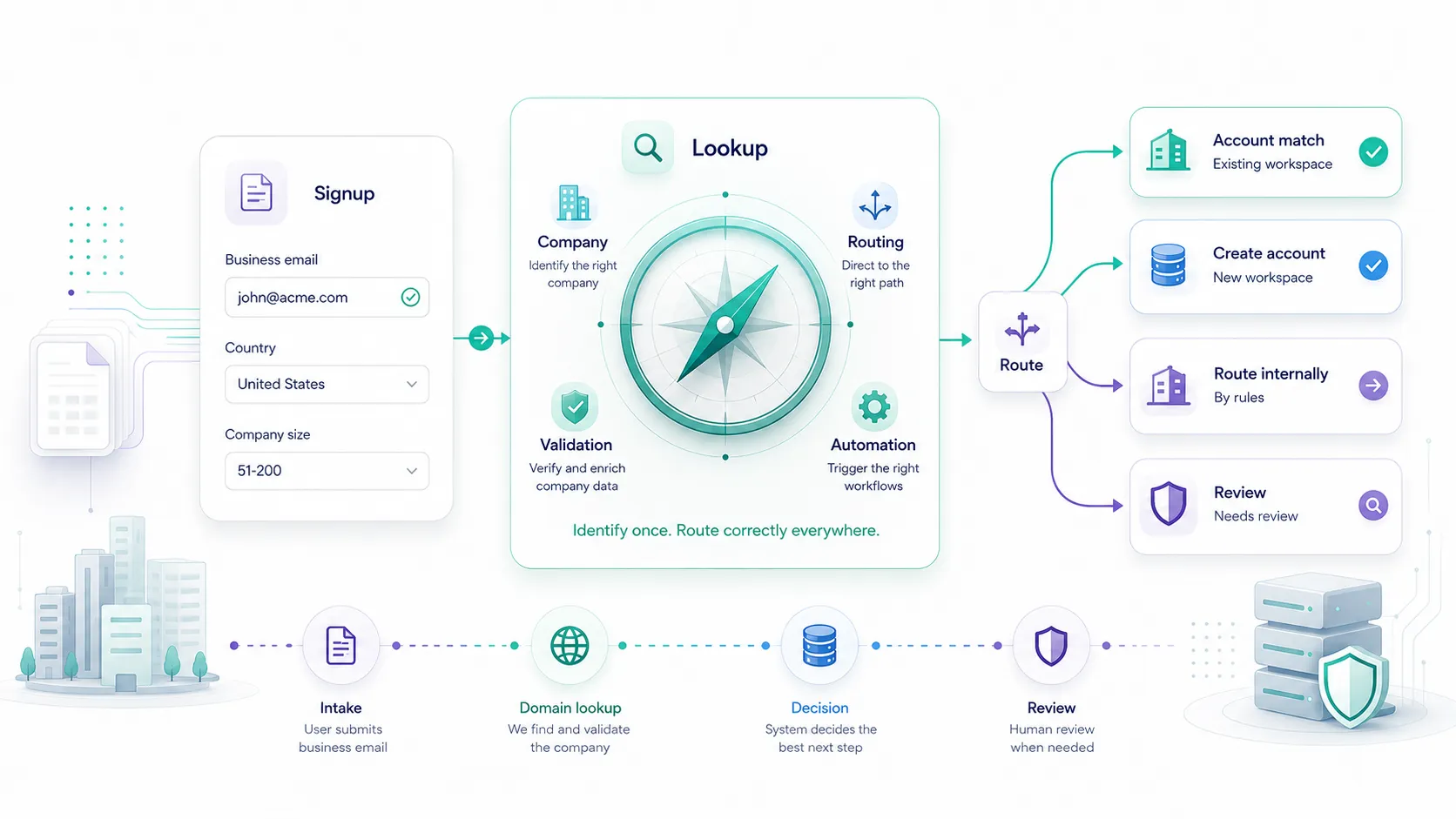
Follow a B2B signup from submitted company name to domain evidence, account matching, review, and final outcome without treating a lookup as proof of account membership.
 S
S
Sora
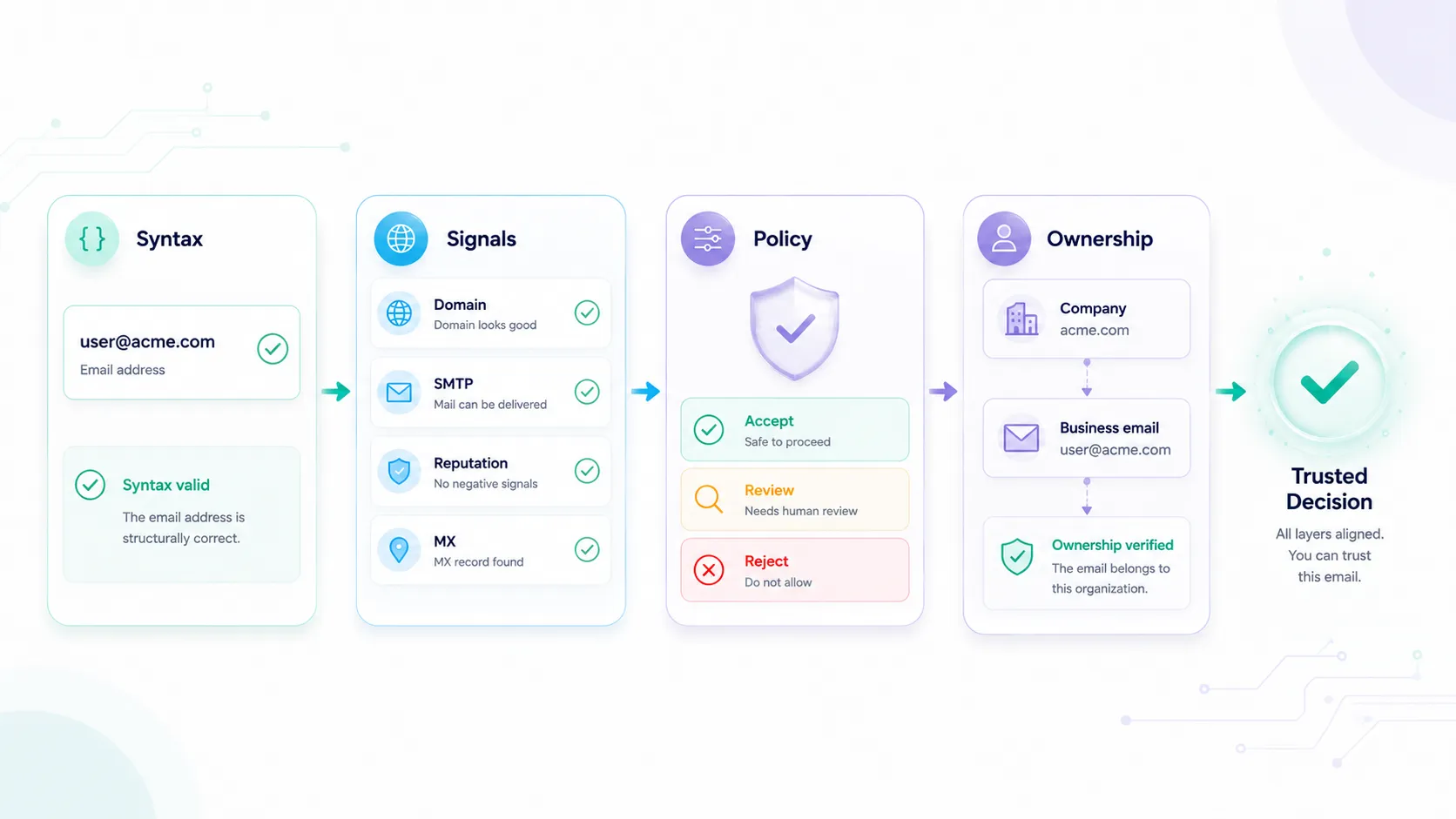
Learn where PHP and Laravel email validation stop, how to add Soryxa decisions safely, and why mailbox ownership still requires a verification step.
S
Sora
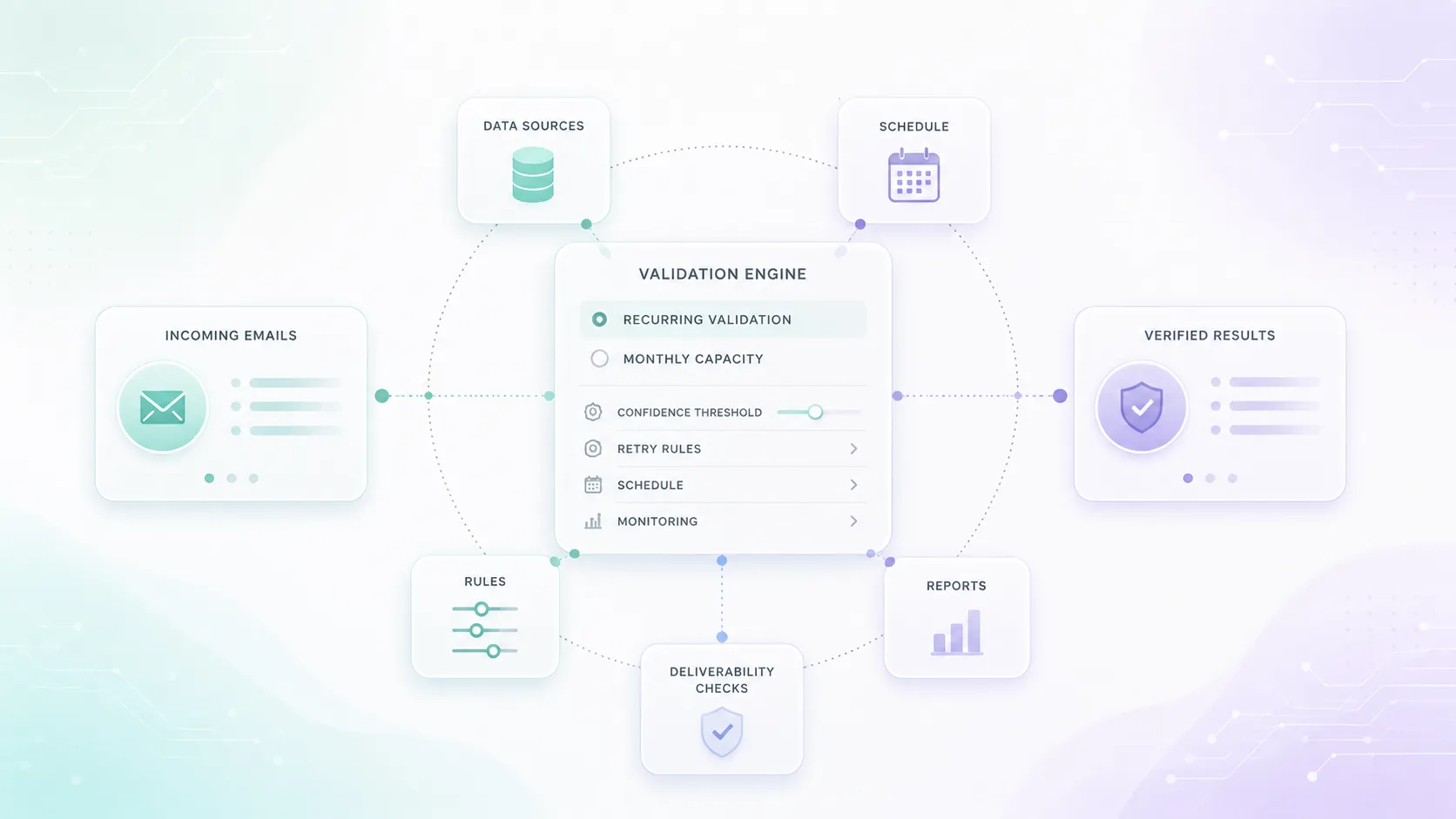
Compare July 2026 published prices for Soryxa subscriptions and ZeroBounce Pay-As-You-Go or ZeroBounce ONE at 2,000, 10,000, and 100,000 validations, including billing and decisioning caveats.
S
Sora