Company Domain Lookup Before Company Data Enrichment
A practical workflow for deciding when to resolve a company name to an official domain before running company data enrichment.

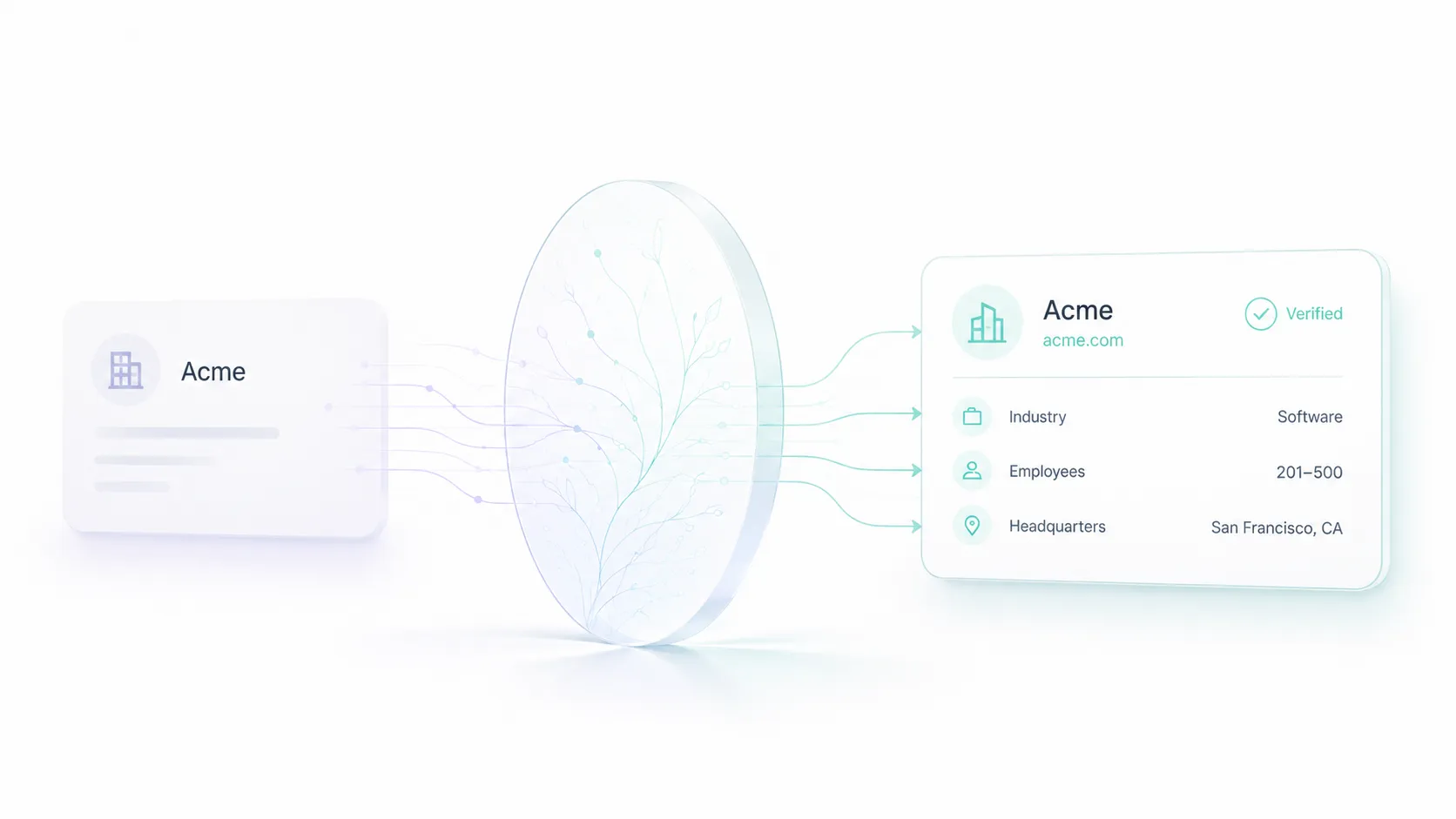
Company data enrichment is much safer when the company identity is already clear. A row with only a company name is not clear enough for every automation path. It might be a legal entity, a product brand, a regional office, a parent company, or a shorthand value copied from a form.
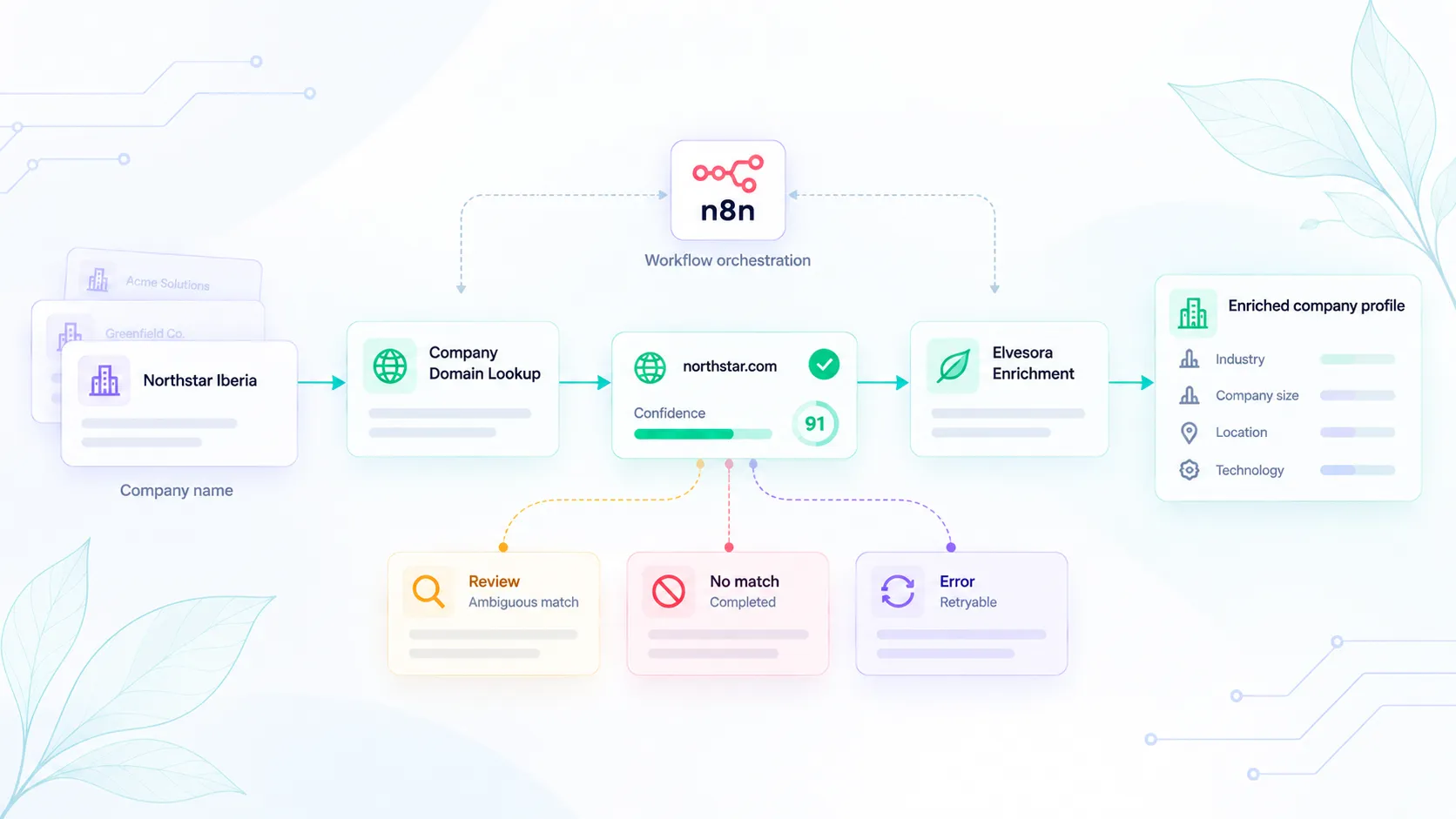
Company domain lookup before enrichment solves a narrow problem: decide whether a name-only or uncertain record can be connected to a likely official domain before enrichment adds company-level context. Lookup answers which company the workflow is probably looking at. Enrichment answers what company-level data should be attached after identity is accepted. We covered the lookup process itself in How to Find a Company's Domain by Name with Elvesora.
If those steps are collapsed, a weak match can turn into a completed enrichment job, then a CRM update, then a routing decision, then a report. By the time the error is noticed, the original uncertainty may be hidden behind several downstream fields.
Quick Answer
Use company domain lookup before company data enrichment when the input record does not already contain a reliable company domain.
- Name-only records should pass through Company Domain Lookup before automatic enrichment.
- Records with trusted domains can usually skip name-to-domain lookup and move directly into Elvesora Enrichment.
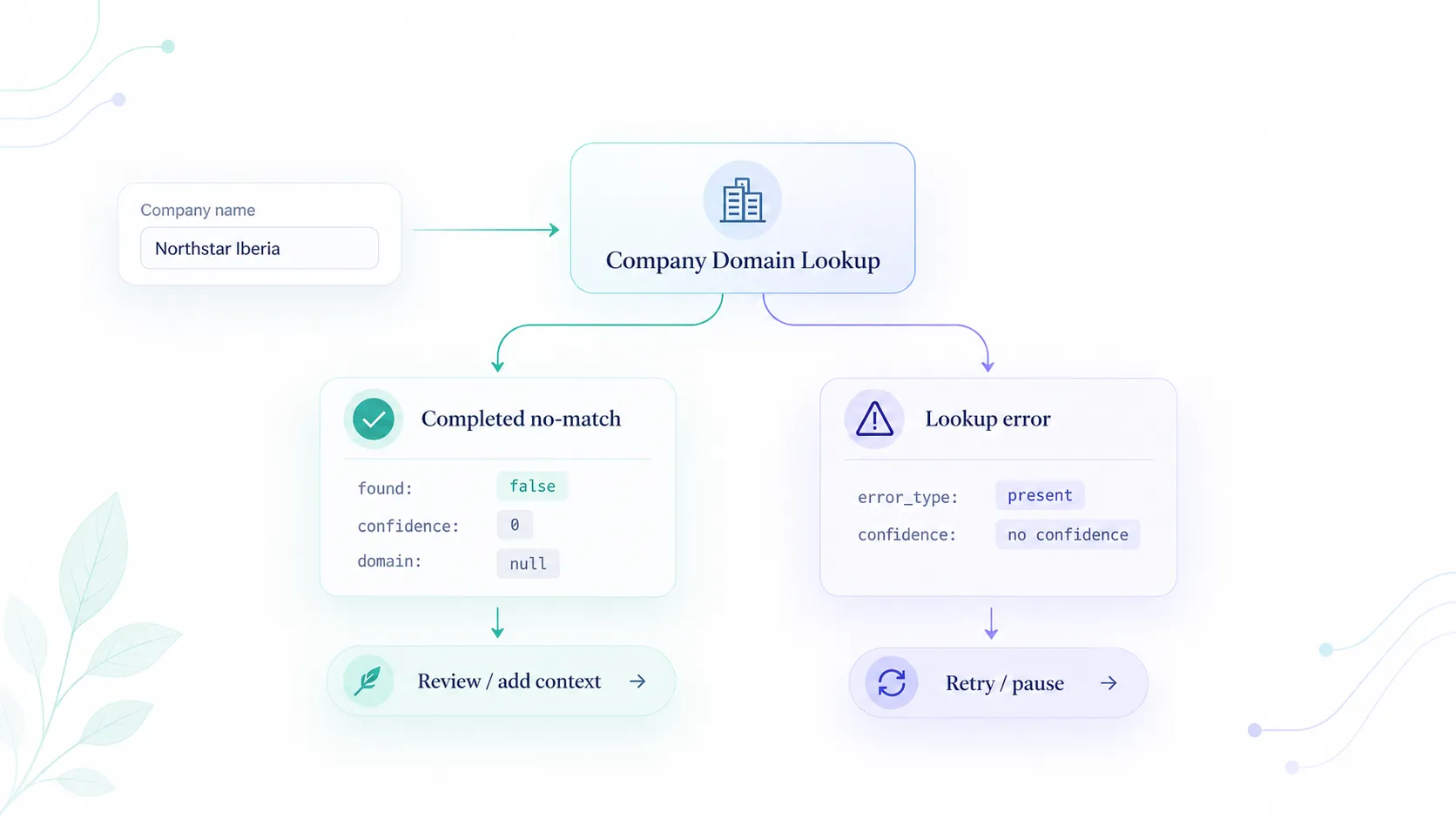
- Ambiguous names should not trigger automatic enrichment until the domain match is reviewed or another signal is added.
- The workflow should store both the submitted company name and the accepted domain.
A good lookup-before-enrichment workflow is not about adding friction. It is about putting uncertainty in the right place: review company identity before enriched data is written into the CRM.
Define The Enrichment Handoff
Before adding API calls, define the handoff between identity resolution and enrichment.
The handoff should answer five questions:
- What input did the source system provide?
- Is there already a trusted domain?
- If the record is name-only, how strong is the domain match?
- What confidence level is allowed to enrich automatically?
- What evidence should be stored for audit and review?
This keeps the workflow from treating every record the same. A domain from an existing account record is different from a typed company name in a signup form. A name plus country context is different from a bare company name in a CSV. A parent company, subsidiary, or regional branch may need more careful review before enrichment starts.
Classify Records Before Enrichment
The safest pattern is to classify the record before enrichment.
| Input state | Recommended handling | Safe automation | Review needed when |
|---|---|---|---|
| Name only | Run company domain lookup before enrichment. | Enrich only when the returned domain is live, confidence is high, and reasons match the submitted name. | The score is weak, several companies share the name, or the result points to a regional or unrelated business. |
| Name plus unverified domain | Check whether the domain and name describe the same company. | Use the domain when it is live and consistent with the submitted name. | The name and domain conflict, the domain redirects to another brand, or the domain appears inactive. |
| Trusted domain already present | Skip name-to-domain lookup and enrich from the domain. | Move into enrichment when the domain source is trusted by the workflow. | The trusted domain is stale, duplicated across accounts, or no longer matches the account name. |
| Business email domain available | Use the email domain as an identity signal, then compare it with the company name. | Enrich when the domain is business-owned and consistent with account context. | The email uses a shared provider, agency domain, contractor domain, or conflicting context. |
| Subsidiary or regional entity | Run lookup with as much context as possible. | Automate only when the domain and context clearly describe the intended entity. | Parent and operating brand use different sites or the region changes the correct domain. |
A lookup becomes much more useful once the workflow knows how to handle each input state.
Build The Workflow
A practical workflow can stay compact while protecting company data quality.
- Keep the raw input exactly as it arrived.
- Normalize only for matching.
- Classify the record as name-only, domain-present, email-derived, existing-account, or ambiguous.
- Run lookup only when it helps.
- Route by confidence, live-domain status, and consistency.
- Enrich the accepted domain, not the ambiguous name.
- Persist the handoff evidence.
Once the company identity is accepted, the next step is enrichment. We walked through that workflow in How to Enrich Company Data with Elvesora.
The result is a pipeline where every enrichment decision can be traced back to the original identity signal. If a report looks wrong or a duplicate account appears, the team can inspect the original input and domain decision instead of guessing why enrichment attached a particular profile.
Store Review And Audit Fields
The domain decision should leave a record of evidence. Recommended fields include:
submitted_company_name;normalized_company_name;submitted_domain, if one existed;accepted_domain;domain_source;lookup_confidence;live_domain_status;match_reason_summary;review_state;enrichment_status;source_system;decided_at.
These fields should be adapted to the actual implementation. The core contract is simple: preserve original input, accepted identity, decision evidence, and enrichment outcome.
Where Elvesora Fits
Company Domain Lookup is the identity-resolution step. It helps turn a company name into a likely official domain with confidence, live-domain status, and reasoning that can support automation or review.
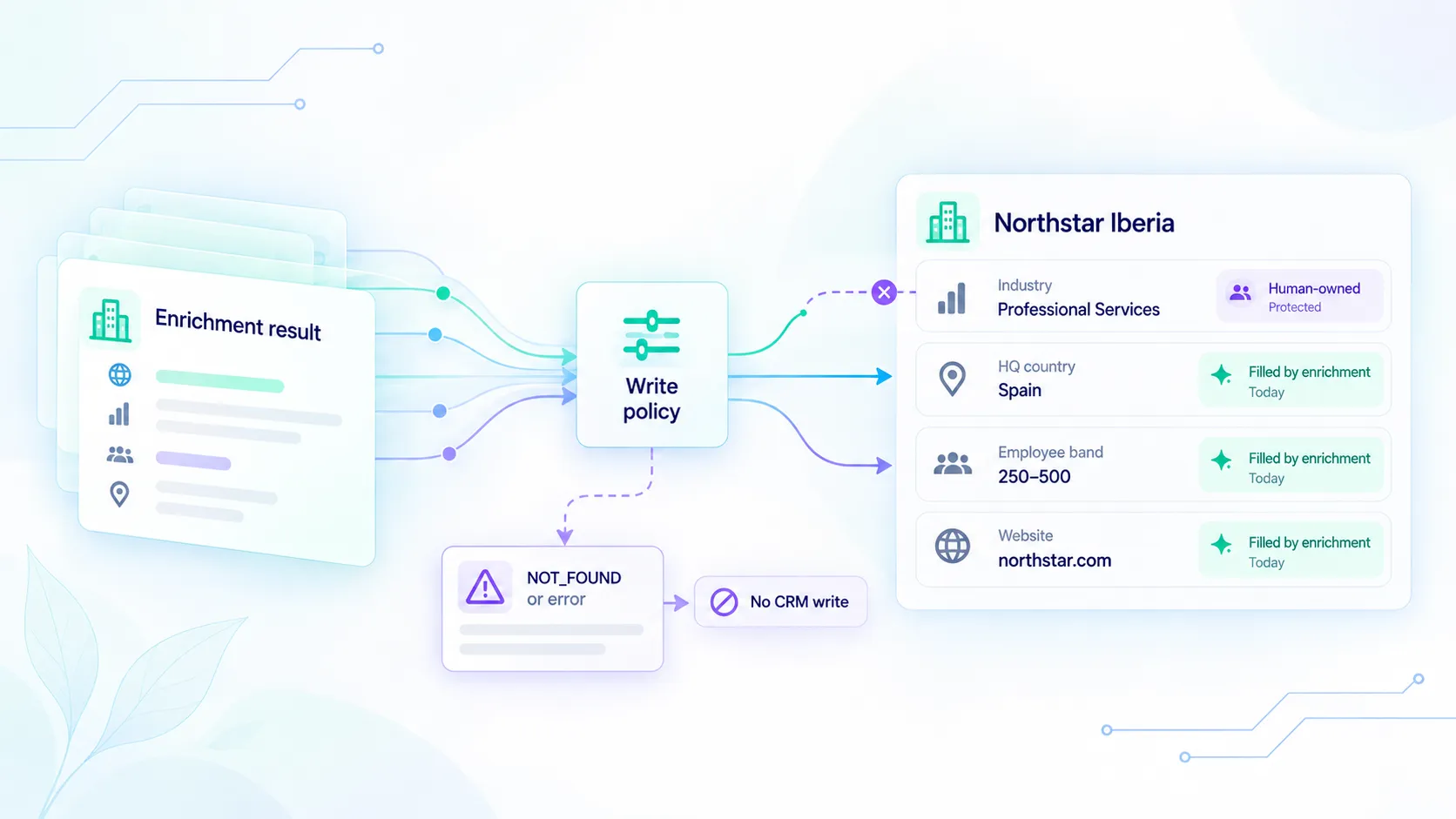
Elvesora Enrichment is the company data enrichment step. After the domain is accepted, enrichment can add company-level context for CRM hygiene, segmentation, routing, and reporting workflows.
Keeping these steps separate protects product boundaries and makes the workflow easier to reason about: resolve the company, then enrich the company record.
When Lookup Is Not Necessary
Lookup should not become a ritual. If a record already contains a reliable company domain, a separate company-name lookup may add delay without improving accuracy.
You can usually skip lookup when the domain comes from an existing account record the team trusts, a verified integration, a prior manual review, or an enrichment job intentionally keyed by domain rather than company name.
Even then, quality control still matters. Skipping lookup does not mean skipping validation. It means choosing the strongest available identity signal.
Common Edge Cases
Parent and subsidiary names need care because the parent company may use one domain while a product line or subsidiary uses another. Regional entities can point to different domains in different countries. Rebrands and redirects can make an old submitted name point to a new brand. Agencies and consultants may submit their own company information when the workflow intends to enrich an end company. Short or generic names can match many businesses.
All of these cases should move through stricter confidence thresholds and review.
Review Policies By Enrichment Risk
Not every enrichment job has the same risk. A staging update that prepares company-level context for review is different from a production CRM write. A nightly analytics cleanup is different from an account ownership change. The lookup-before-enrichment policy should reflect that difference.
For low-risk staging, the workflow can store more candidate domains as long as the accepted domain remains separate from the source value. The result is useful because it helps reviewers work faster, and mistakes are easier to correct before they reach trusted fields.
For medium-risk enrichment, require stronger evidence. The domain should be live, confidence should meet the policy threshold, and the match reasons should be consistent with the submitted name and available context. If the record came from a noisy source such as a mixed CSV import, use stricter review rules than a source with prior trusted domains.
For high-risk CRM writes, treat lookup as one input. Do not automatically overwrite canonical domains, merge accounts, or change routing keys only because enrichment needs a domain. Hold the enrichment job until the company identity is accepted for that specific action.
This risk-based policy is easier to maintain than a single global threshold. It lets clear records move quickly while keeping uncertain records out of irreversible workflows.
Measure The Handoff
The lookup-before-enrichment handoff should produce metrics. Track how many records skipped lookup because a trusted domain already existed, how many name-only records were accepted, how many entered review, how many enrichment jobs were blocked, and how many accepted domains were later corrected.
Those numbers help teams tune the policy. If many records are blocked because source data lacks country or website context, the intake workflow may need better optional fields. If accepted domains are rarely corrected, the workflow may be ready for more low-risk automation. If corrections are common, enrichment should stay behind review.
Final Recommendation
Run company domain lookup before company data enrichment when the record is name-only, ambiguous, or based on a weak identity signal. Skip lookup when a trusted domain is already present and the workflow is intentionally keyed by domain.
The rule is simple: do not enrich uncertainty. Resolve or review the company identity first, then send the accepted domain into enrichment. That creates cleaner CRM updates, clearer routing decisions, and company-level records that are easier to audit later.