What Happens When Email Validation Is Inconsistent Across Systems
Inconsistent email validation leads to fragmented data and misaligned workflows. Learn why shared validation rules are essential for reliable systems.


Introduction
Email validation rarely lives in just one place.
It usually shows up across product signups, marketing forms, CRM imports, and internal tools.
Each system validates emails in its own way.
At first, this seems harmless.
Over time, it creates a problem that is difficult to see but easy to feel.
Inconsistency.
The same email, different outcomes
Consider a simple example.
The same email enters different parts of your system:
- accepted during product signup
- flagged in a marketing form
- stored without validation in the CRM
- rejected by an internal tool
Each system applies its own rules and produces a different outcome.
This usually happens because decision rules are not clearly defined across systems. We explore this in more detail in Why Email Validation Fails Without Clear Decision Rules.
The result is not just inconsistency in validation.
It is inconsistency in your data.
For example, a free email might be accepted during signup, flagged in a marketing form, and ignored during a CRM import. By the time the difference is noticed, multiple systems may already be working with conflicting data.
Why inconsistency is hard to detect
Inconsistent validation does not break systems immediately.
There is no single point of failure.
Instead, small differences accumulate:
- slightly different datasets
- conflicting records
- unclear ownership of data quality
At first, everything still works.
But over time, teams begin to notice:
- reporting does not align
- segmentation produces unexpected results
- outreach feels less targeted
The issue is not visible in one place.
It exists across the system, which makes it much harder to trace back to a single cause.
Fragmentation across teams
When validation rules are not shared, each team adapts independently.
- product optimizes for signup conversion
- marketing optimizes for lead volume
- sales works with whatever enters the CRM
Each team makes reasonable decisions.
In isolation, each choice makes sense.
But those decisions are not aligned.
This leads to:
- different definitions of acceptable emails
- inconsistent lead quality
- friction between teams
Validation becomes a source of misalignment instead of a control mechanism.
The downstream impact on data workflows
Inconsistent validation affects every layer of the data system.
This is why validation should be treated as part of a broader data system, not as an isolated step. We cover this in more detail in How Email Validation Fits into Clean Data Workflows.
Enrichment
Enrichment relies on clean inputs.
If validation allows inconsistent or low-quality emails:
- enrichment attaches to weak profiles
- firmographic data becomes less reliable
Prospecting
Prospecting depends on accurate company identification.
When validation is inconsistent:
- contact-level data becomes unreliable
- account targeting loses precision
CRM and reporting
Inconsistent inputs lead to:
- duplicate records
- conflicting metrics
- unreliable dashboards
Each layer assumes the data entering the system is consistent.
When that assumption fails, everything becomes harder to trust.
Why validation logic drifts
Validation inconsistency is rarely intentional.
It usually happens because:
- rules are implemented separately in different systems
- logic lives inside code instead of a shared layer
- updates are made in one place but not others
Over time:
- rules diverge
- edge cases are handled differently
- behavior becomes unpredictable
What started as small differences becomes structural drift.
Consistency as a system property
Validation should not depend on where it runs.
It should depend on shared rules.
A consistent validation system ensures that:
- the same email produces the same outcome everywhere
- rules are defined once and applied across systems
- updates are centralized and predictable
Consistency does not require identical strictness in every workflow.
It requires alignment in how decisions are made.
Validation as a centralized decision layer
Instead of distributing validation logic across systems, it can be centralized.
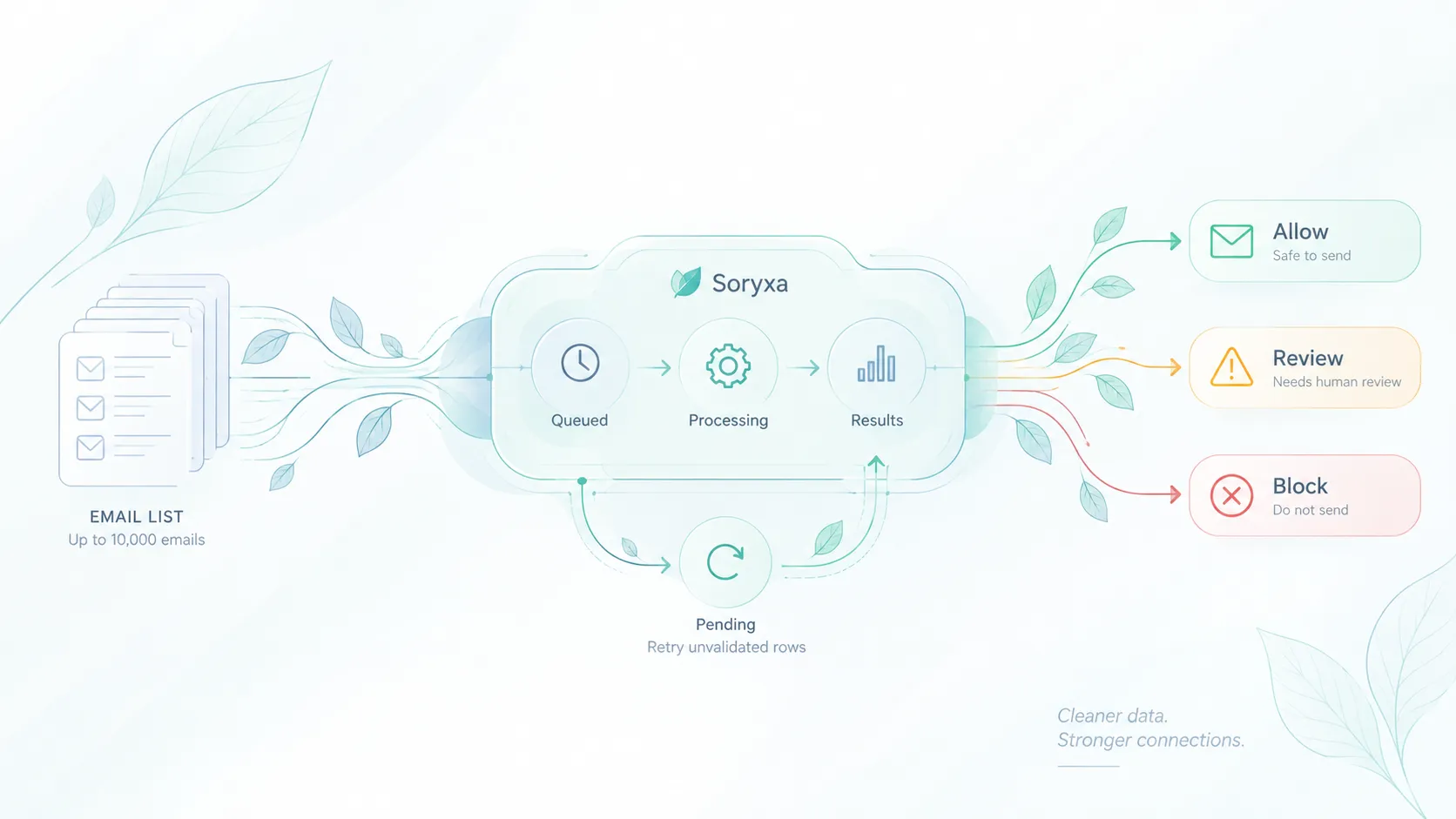
A decision layer defines:
- what is allowed
- what requires review
- what is blocked
This layer sits between data input and downstream workflows.
Designing those rules is a critical step. We’ve outlined a practical approach in How to Design Email Validation Rules for B2B Workflows.
It ensures that:
- decisions are consistent
- data quality is controlled at entry
- workflows remain aligned
Validation becomes part of the system architecture, not just a feature.
Where Soryxa fits
Soryxa is designed to centralize email validation decisions.
Instead of relying on separate implementations, teams define rules once and apply them everywhere.
Soryxa provides:
- configurable decision rules
- allow, review, and block outcomes
- consistent API-based validation
- visibility into validation results
This ensures that:
- the same logic applies across product, marketing, and internal systems
- updates do not require rewriting validation logic in multiple places
- data entering the system is consistent
Consistency reduces invisible risk
Inconsistent validation does not always cause immediate failures.
It creates hidden risk.
- data becomes harder to trust
- workflows become harder to align
- decisions become harder to explain
Consistency reduces this risk.
It makes systems more predictable.
Final thoughts
Email validation is not just about checking emails.
It is about defining how your system behaves.
When validation is inconsistent, data starts to fragment, workflows drift, and trust gradually declines.
The goal is not to validate more emails.
It is to ensure that every email is evaluated by the same rules, no matter where it enters your system.