Company Domain Lookup in Partner Onboarding: Resolution vs Verification
A partner-specific framework for resolving a likely company domain, verifying control separately, preventing duplicate accounts, and approving safely.

Quick answer
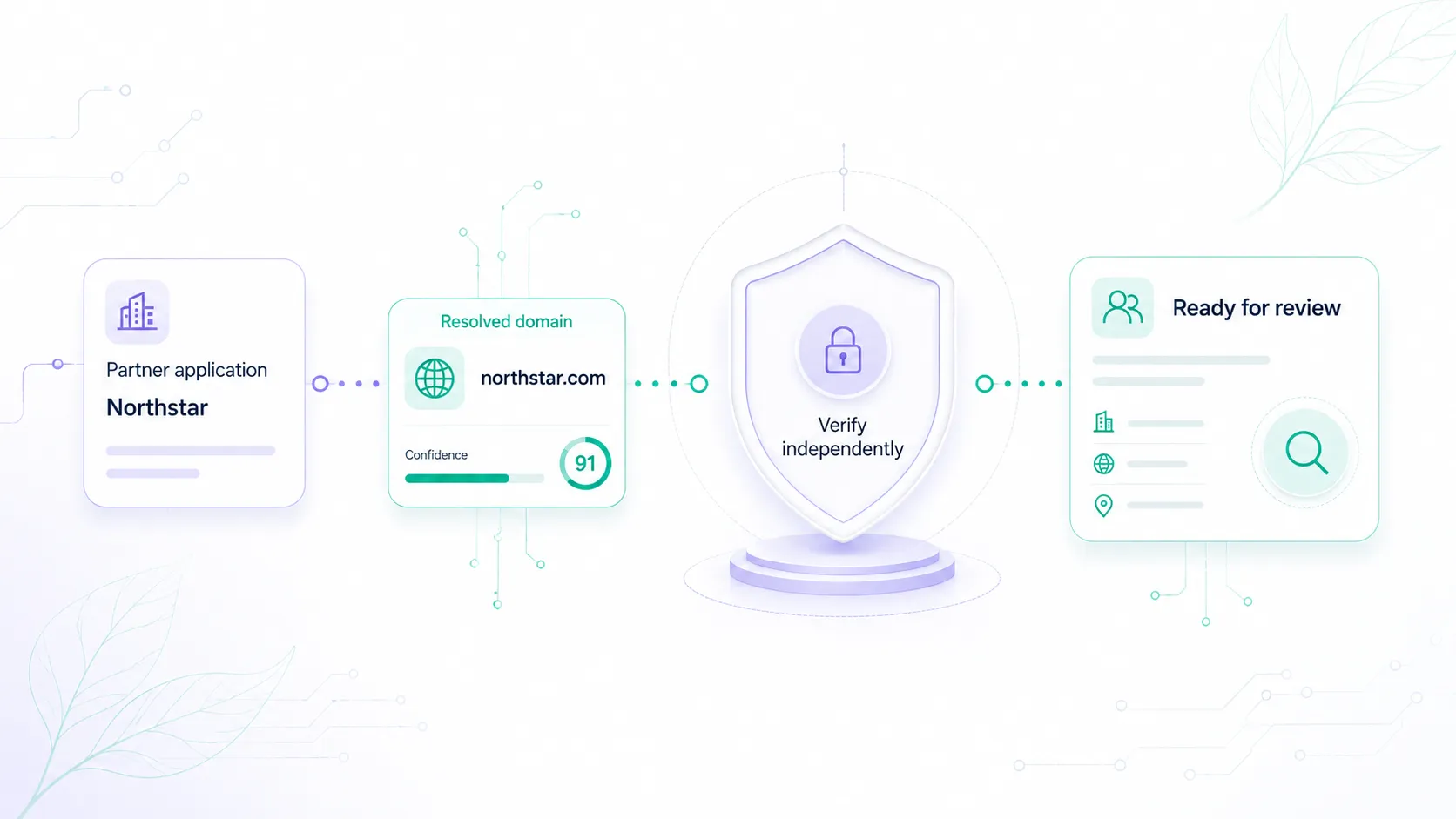
Company domain lookup can fit near the start of partner onboarding, but it should answer only one question: which website domain is the most likely match for the company named in the application?
It does not prove that the applicant controls the domain, works for the company, represents the legal entity, or qualifies for the partner program. Treat those as separate decisions:
- Resolve a likely official domain from the submitted company name.
- Reconcile that candidate with the applicant's email domain and submitted website.
- Verify domain control, affiliation, identity, or business details according to the risk of the program.
- Apply the program's eligibility rules and record the approval decision.
That separation makes domain lookup useful without allowing a confident match to become accidental proof.
Why partner onboarding needs more than a company-name field
A partner application often arrives with several imperfect identity signals:
- a trading name instead of a legal name;
- a work email that uses a parent, regional, or legacy domain;
- a website entered with a subdomain, redirect, or country-code domain;
- an agency applying on behalf of a customer;
- a company that already has another partner account;
- a consultant using a personal or shared-services email address.
If the workflow uses only the submitted company name, duplicates such as Northstar, Northstar Ltd, and Northstar Iberia can become separate partner organizations. If it trusts the email suffix alone, an agency, contractor, or parent-company employee can be attached to the wrong organization. If it treats a reachable website as proof of legitimacy, it confuses a technical signal with a business decision.
Real partner programs also keep these checks separate. PartnerStack uses verified domains for team joining, while Microsoft Partner Center documents email, identity, employment, business, and additional verification as separate checks. MoonPay connects website review to the legal entity under review, and Enclave requires a primary business domain before customer creation.
The shared lesson is not that every program needs the same checks. It is that a domain can support onboarding while answering only the question assigned to that check.
The four evidence layers
| Layer | Question | Evidence | Safe outcome |
|---|---|---|---|
| Domain resolution | Which domain is the likely official website for this company name? | Candidate domain, confidence, positive and lower-confidence reasons, reachability context | Store a domain candidate or keep the field blank |
| Evidence reconciliation | Do the submitted name, email suffix, website, geography, and company context agree? | Application fields plus the lookup result | Continue, request clarification, or route to review |
| Control and affiliation verification | Can the applicant demonstrate control of the relevant email, domain, or website, and any required relationship to the company? | Email link, DNS record, website-file challenge, administrator confirmation, or another program-approved method | Mark the specific proof as verified or unresolved |
| Business and program approval | Is the legal business real, accurately represented, and eligible for this partner program? | Registration documents, identity or employment checks, contracts, territory, program rules, sanctions or compliance checks where applicable | Approve, reject, or request more information |
Do not collapse these layers into one verified flag. A resolved candidate can be strong while control remains unproven. Domain control can be proven while the applicant still fails program eligibility. A legal business can be legitimate while the person applying lacks authority to represent it.
Where company domain lookup fits
Run lookup after the application has captured the source values and before partner-account creation, deduplication, territory assignment, or automated approval depends on the domain.
Preserve the raw inputs first:
{
  "application_id": "pa_01842",
  "submitted_company_name": "Northstar Iberia",
  "submitted_website": "https://northstar.es/partners",
  "applicant_email_domain": "northstar.com",
  "country": "ES",
  "partner_type": "reseller"
}
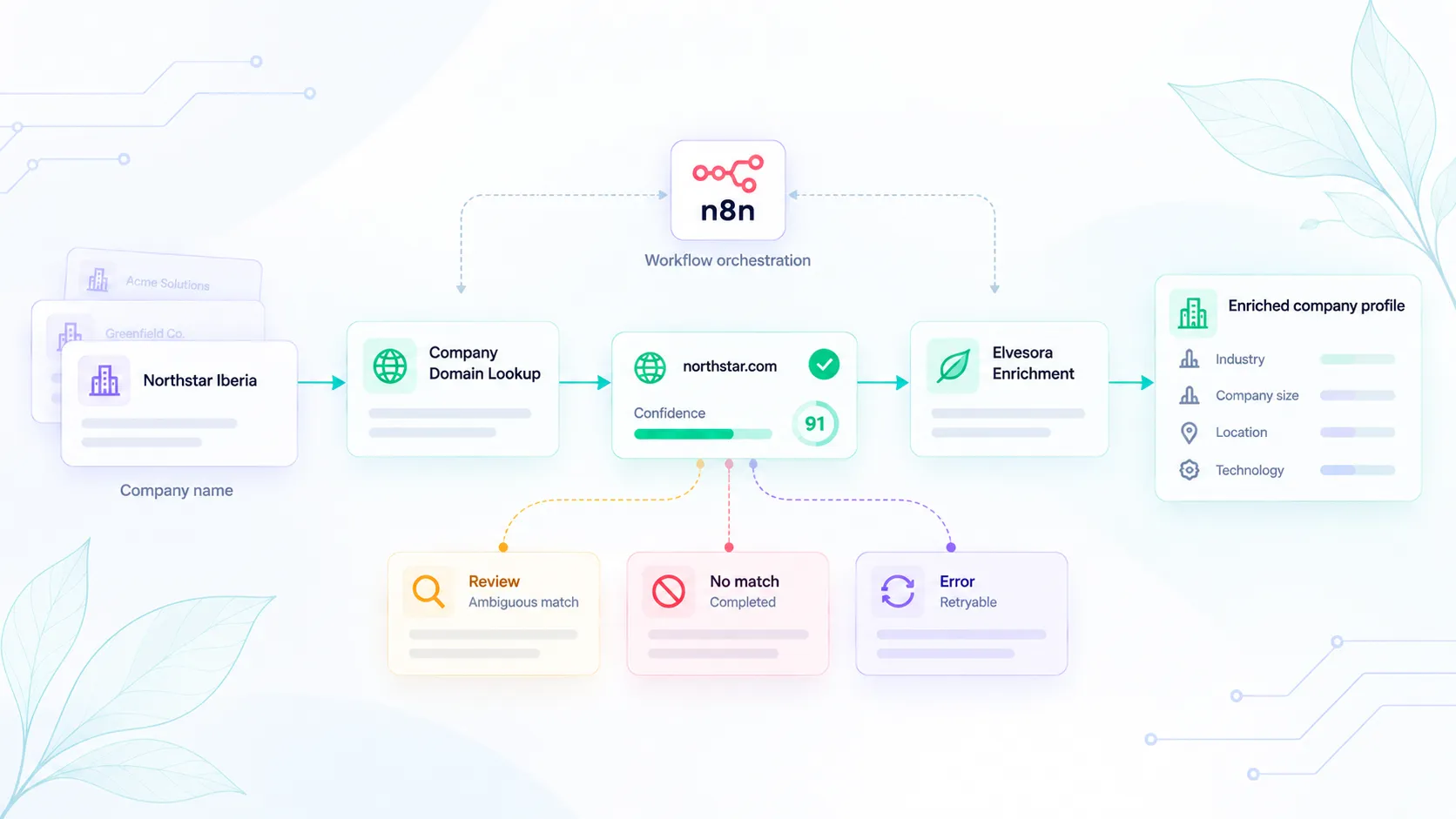
Then send the company name and useful disambiguating context to Company Domain Lookup. The API contract accepts company_name plus optional additional_context and returns a likely official domain candidate with found, confidence, reasons, lower_reasons, nullable is_live, and cached.
For this example, context such as Spain, reseller application, submitted website northstar.es is more useful than repeating the company name. It helps distinguish a regional organization from similarly named businesses without overwriting the original application.
Interpret the response as evidence, not permission
Elvesora's documented bulk-review workflow uses 85 and above as a starting band for auto-verifying a domain match. That is not a universal threshold and it is not permission to auto-approve a partner. Partner onboarding can use the score as one routing signal while requiring the other evidence layers to pass.
| Lookup state | Reconciliation state | Recommended partner-onboarding action |
|---|---|---|
| Found, high confidence | Candidate agrees with the submitted site and work-email domain | Accept the domain as the likely company identity; continue to any required control, affiliation, and eligibility checks |
| Found, medium confidence | Evidence agrees but reasons show ambiguity | Keep the candidate in review; ask for context or inspect the returned reasons before accepting it |
| Found, any confidence | Email, submitted site, or legal name conflicts with the candidate | Do not merge or approve; preserve every value and investigate the relationship |
| Found, low confidence | Evidence is incomplete | Keep the domain unaccepted and request a website, country, industry, or other disambiguating detail |
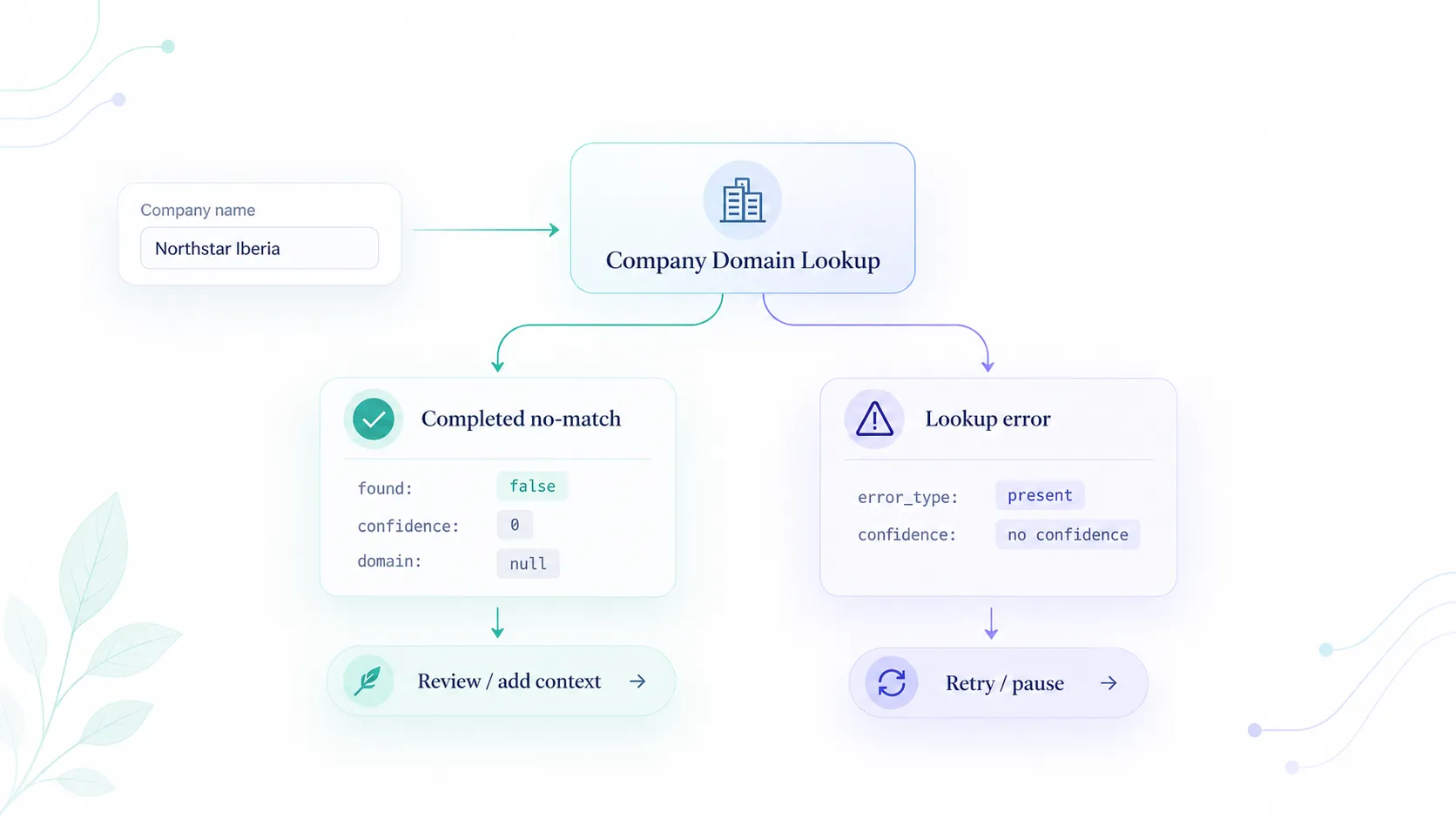
| Completed no-match | found: false, confidence: 0 |
Leave the candidate domain blank; request evidence or retry with better context instead of guessing |
| API error | No completed match and no confidence score | Retry according to the typed error; do not route the record as a low-confidence match |
is_live also has a narrow meaning: it indicates whether the returned domain appeared reachable when evaluated. It is nullable, and cached matters when assessing freshness. Reachability is not proof of ownership, company legitimacy, or current affiliation.
A worked partner-application decision
Consider a fictional self-service application from Northstar Iberia:
- The application includes
northstar.esas the website andana@northstar.comas the contact. - Lookup returns
northstar.comas the likely official domain with strong supporting reasons. - The workflow stores
northstar.comas the candidate but does not discardnorthstar.es. - A duplicate search finds an existing global partner organization on
northstar.com. - The country-code site and application country support a possible regional entity or team.
- The system routes the application to a channel manager with the parent account, regional application, and both domains visible.
- The program verifies the applicant's required affiliation and determines whether Iberia should join the existing organization or remain a separate regional team.
- Only then does the program create or link the partner record and apply eligibility rules.
The same-domain match prevented an unnecessary duplicate, but it did not decide the company hierarchy. This matters because even a platform that supports verified-domain joining can allow separate regional teams; PartnerStack documents that exact option in its own workflow.
Use different policies for invited, self-service, and imported partners
The next action should reflect how the record entered the program.
| Intake path | Existing trust | Useful lookup role | Typical guardrail |
|---|---|---|---|
| Invited partner | A channel manager selected the company or contact | Normalize the organization and find an existing partner record | Confirm the invitation belongs to the same entity before linking accounts |
| Self-service application | The applicant supplied all identity fields | Resolve the candidate, compare evidence, and detect possible duplicates | Require explicit review when the candidate conflicts with the email, site, legal name, or territory |
| Bulk migration or import | Source-system history exists but fields may be stale | Standardize candidates before dedupe and hierarchy mapping | Stage results, preserve source IDs, and review merges before changing the system of record |
An invitation may justify a lighter company-resolution review, but it does not justify skipping authentication or granting access to the wrong organization. A bulk import may contain historically approved partners, but old domains and acquisitions still require controlled reconciliation.
Partner-specific edge cases
Free or personal email with a credible business website
A personal address can mean an early-stage business, independent consultant, or applicant who cannot access a corporate mailbox during onboarding. Resolve the company candidate, then request another program-approved control or business proof. Do not turn a free-email address into a fraud verdict.
Brand domain differs from the corporate email domain
The applicant may market under a product brand while employees use the parent company's domain. Keep the brand, legal entity, submitted website, email suffix, and resolved candidate as separate fields until the relationship is confirmed.
Parent company, subsidiary, or acquisition
A shared parent domain is a strong duplicate-search signal, not an automatic merge key. Record the hierarchy and decide whether contracts, payouts, territories, or permissions require separate partner organizations.
Agency or reseller applying for a customer
Resolve the applicant's own company identity. Store represented customers or managed domains in a separate relationship model. Otherwise, the agency can be attached to its customer's organization.
Regional and country-code domains
example.com, example.es, and example.de may represent one company, regional sites, or separate legal entities. Use geography and program structure as context; do not strip every domain to one global parent automatically.
Subdomains and hosted pages
partners.example.com may be controlled by the same organization as example.com, while example.platform-host.com may be a tenant on someone else's domain. Preserve the submitted hostname and decide which ownership scope the program actually needs to verify.
Rebrands, redirects, and legacy domains
A redirect can support a relationship between old and new brands, but it may also be stale. Keep both domains, the observation time, and the evidence used before changing the canonical partner identity.
Internationalized domains
Internationalized domain names can have a user-facing Unicode form and an ASCII DNS form. Store a normalized comparison form alongside the display form, and review visually confusable characters instead of relying on appearance alone. ICANN's IDN overview explains the Unicode and ASCII representations.
Prevent duplicate partner accounts without unsafe merges
Search for possible duplicates using more than one key:
- accepted candidate domain and known domain aliases;
- normalized trading and legal names;
- parent and subsidiary relationships;
- source-system partner ID;
- program, region, currency, payout, or contract scope;
- prior verification records and their validity periods.
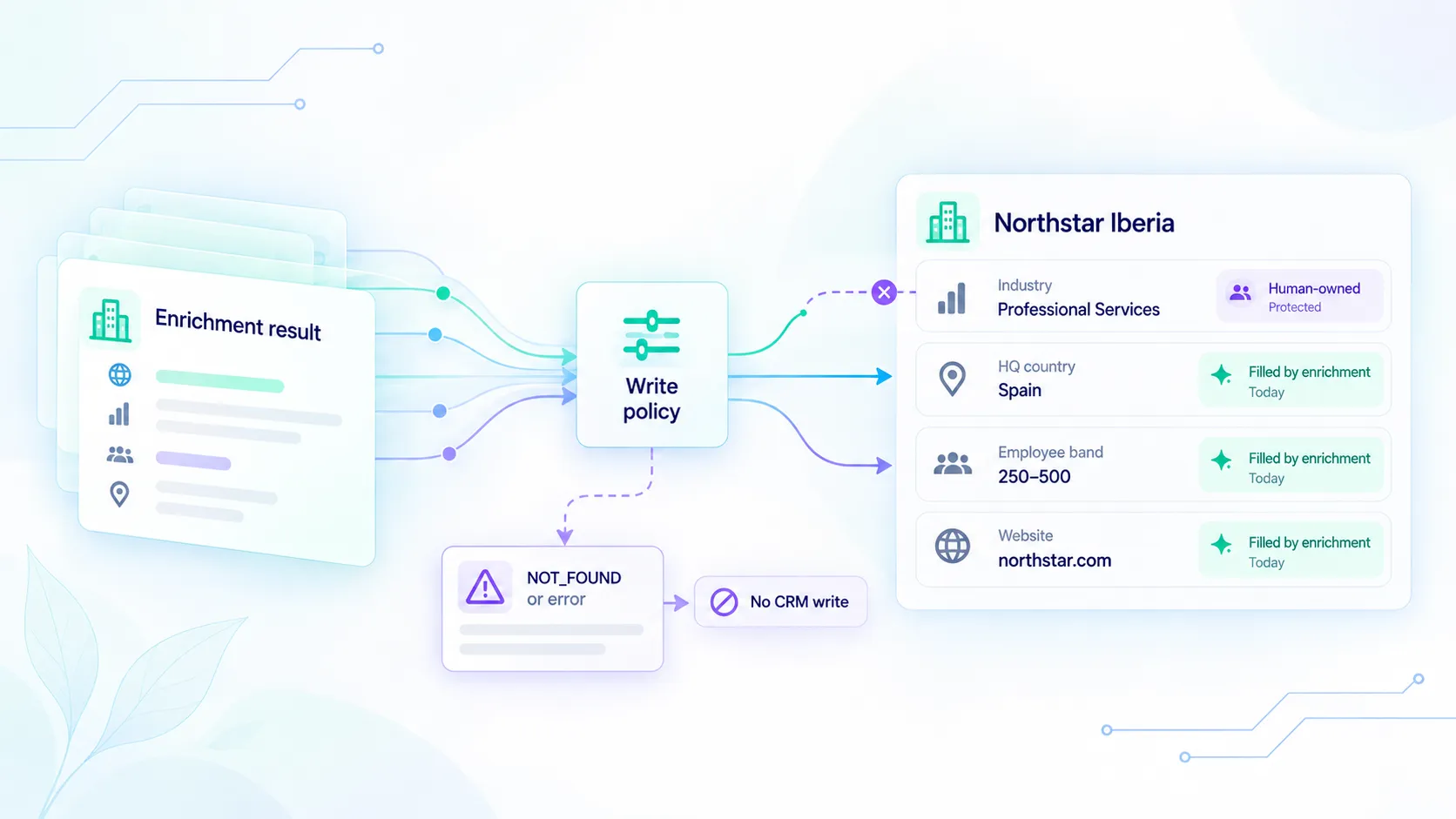
The same principle applies to company domain matching for CRM cleanup, routing, and record merges: a domain is useful evidence for finding related records, but it should not become an automatic merge key.
Return candidates to the reviewer instead of silently merging them. A useful review screen should explain why each possible duplicate appeared: exact domain, alias domain, redirect relationship, similar name, shared parent, or a prior reviewer decision.
When two applications use the same domain, valid outcomes can include:
- link the applicant to the existing partner organization;
- create a separate regional or program-specific team under the same company;
- create a subsidiary record linked to the parent;
- reject an unauthorized duplicate;
- keep both records pending while affiliation is verified.
Store an audit trail for every layer
A single domain column and verified=true cannot explain what happened. Store enough detail to reconstruct the decision:
submitted_company_name
submitted_legal_name
submitted_website
applicant_email_domain
candidate_domain
lookup_found
lookup_confidence
lookup_reasons
lookup_lower_reasons
lookup_is_live
lookup_cached
lookup_checked_at
domain_resolution_status
domain_control_verification_method
domain_control_verification_status
domain_control_verified_at
affiliation_status
business_verification_status
partner_eligibility_status
duplicate_partner_id
company_relationship_type
reviewer_id
decision_reason
policy_version
decided_at
Keep statuses explicit. For example:
candidate_resolved
needs_evidence_reconciliation
needs_domain_control_verification
domain_control_verified
needs_affiliation_review
needs_business_review
ready_for_program_decision
approved
rejected
This makes it possible to change one layer without falsely resetting or approving another. It also supports appeals, policy changes, and re-verification after a domain or company-structure change.
Failure and review rules
Define these rules before connecting lookup to partner-account creation:
- Never guess a domain after a completed no-match.
- Never interpret an API error as confidence
0; it is an incomplete lookup, not a negative result. - Never overwrite the submitted site or email domain with the candidate.
- Never call the candidate
verifieduntil the intended control check has passed. - Never use reachability alone as proof of ownership or legitimacy.
- Never merge partner organizations solely because they share a domain.
- Never let a successful domain-control check bypass business, identity, contract, or eligibility rules that the program requires.
- Require a reason whenever a reviewer accepts conflicting evidence or overrides a policy.
- Version the policy so an old decision can be interpreted under the rules that produced it.
What to measure after launch
Measure workflow quality instead of claiming an unverified conversion uplift:
- percentage of applications with a candidate domain;
- percentage with aligned, missing, or conflicting website and email evidence;
- manual-review rate by lookup state and intake path;
- duplicate-partner candidates found before account creation;
- reviewer override rate and the reasons for overrides;
- time from application to domain resolution, evidence verification, and final decision;
- false merges, duplicate accounts created, and corrected company hierarchies;
- re-verification rate after rebrands, acquisitions, or domain changes;
- approval and rejection rates by evidence state, without treating correlation as proof of causation.
Review a sample of accepted and rejected cases regularly. A high automation rate is not a success if the system attaches applicants to the wrong partner organization.
Implementation checklist
- Preserve the raw company name, legal name, website, email domain, region, and partner type.
- Run lookup only when the workflow lacks an accepted company-domain identity or needs to reconcile conflicting inputs.
- Send disambiguating context when it is relevant and trustworthy.
- Store the complete lookup evidence and request time.
- Separate domain resolution, domain control, affiliation, business review, and program approval states.
- Search for existing partner organizations before creating a new one.
- Model parent, subsidiary, regional, agency, reseller, and represented-customer relationships.
- Route no-match, errors, and evidence conflicts differently.
- Require reviewer reasons for overrides and merges.
- Measure errors and corrections, not only speed or automation volume.
Frequently asked questions
Does a high-confidence domain match verify the partner?
No. It means the domain is a strong candidate for the company name under the lookup evidence. It does not prove control, employment, legal identity, authority to represent the company, or partner-program eligibility.
Can a matching work-email domain auto-join an existing partner account?
Only if your program has separately verified the relevant domain and intentionally permits that enrollment behavior. A matching suffix alone should not grant organization access. Programs also need a policy for subsidiaries, contractors, shared domains, and regional teams.
What should happen when the submitted website and work email disagree?
Keep both values, resolve a candidate with useful context, and route the relationship to review. The difference may be legitimate—a brand, parent company, region, agency, acquisition, or legacy domain—or it may indicate the wrong organization.
Should a completed no-match block the application?
Not automatically. Leave the candidate domain blank and request better evidence or context. Whether onboarding can continue without a domain depends on the partner program, not on the lookup service.
Is a live website proof that the company is legitimate?
No. Reachability is a technical observation. Business verification and program eligibility require their own evidence and policy.
Sources and product boundary
Company Domain Lookup resolves a company name to a likely official website domain with confidence and reasons. It is not domain-ownership verification, identity verification, employment verification, KYB, legal advice, an email finder, or a lead database.
A resolved domain should make partner onboarding easier to route, deduplicate, and review. It should not decide who the applicant is, what they control, or whether the program should approve them. Those decisions need their own evidence.